Growing blog traffic feels exciting. But it should convert into revenue as well, right?
You write detailed guides and recommend tools you genuinely trust. Readers click your affiliate links with interest. But the moment they leave your site, the momentum breaks. Now they’re comparing prices and opening new tabs. They forget why they clicked in the first place.
That redirect is where most earnings quietly disappear.
Traditional affiliate models were built around sending traffic away. You build trust. Someone else owns the checkout. And you earn a small percentage, if the sale happens at all.
Now you, a blogger, can monetize content by embedding Shopify products directly inside your articles. It allows readers to browse and purchase without leaving the page. It increases conversion rates and creates new revenue opportunities beyond traditional affiliate links.
This article explores how to monetize a blog with products including four practical monetization models that work even if you don’t own the products yourself. Because the real opportunity isn’t just driving traffic. It’s keeping the sale where the attention already is.
If you want a deeper, step-by-step walkthrough of the technical side, our complete guide on embedding Shopify products on any website explains the full setup process in detail, from creating your first component to publishing it on WordPress or other platforms. It walks through everything clearly so you can move from idea to live embed with confidence. If you’re serious about learning how to monetize a blog with products without disrupting your reader experience, that guide shows exactly how to do it.
Table of Contents
Why Affiliate Links Are Losing Their Edge
Affiliate links used to feel like the simplest way to monetize a blog. Now they often feel like the fastest way to lose a sale.
Every affiliate link is an exit door. The moment a reader clicks, they leave your page, your messaging, and your momentum. Your conversion window starts shrinking immediately. Instead of buying, many people do what they’ve been trained to do by marketplaces like Amazon: bounce, browse, compare, and postpone.
Even tracking is getting harder. Ad blockers can interfere with attribution. Cookies expire. People click on mobile and purchase later on desktop. The journey breaks, and the commission disappears.
Here’s what the numbers look like in real life. Typical affiliate conversion rates often sit around 1–3%, which means most readers who click never buy. And the drop-off compounds. A reader goes from your blog to a store landing page, then to a product page, then to cart, then to checkout. Every extra step loses more people.
Sponsored posts have their own problem. They can bring pageviews, but many brands struggle to see trackable ROI, so they hesitate to pay premium rates.
The shift is already happening elsewhere. Social commerce proved one thing clearly: people buy where they discover.
Blogs are next.
The question isn’t whether to monetize. It’s whether the buying experience matches how modern readers behave. Embedded commerce closes that gap by keeping the purchase flow inside the content.
The 4 Ways Bloggers Can Monetize with Embedded Products
Depending on whether you have your own Shopify store or work with brands, embedding opens up different income streams. Here are the four main models.
- You’re the Merchant: Sell Your Own Shopify Products Through Your Blog
- Earn Commissions: Work With Brands Using Embedded Components
- Sponsored Content That’s Actually Measurable
- Gift Guides & Listicles as Shoppable Evergreen Pages
Model#1 You’re the Merchant: Sell Your Own Shopify Products Through Your Blog
This model is for bloggers who already sell something.
Maybe you run a Shopify store with merch, digital downloads, supplements, prints, templates, or courses. You have products. You have traffic. But they live in separate places.
The old way is simple. You add a “Shop My Store” link in your navigation or footer. Readers have to leave the article, search your store, and find the right product. Most never do.
The embedded approach changes that.
Instead of linking away, the product appears directly inside the content. A recipe blogger places their cookbook right below the recipe. A fitness blogger embeds their supplement inside the workout guide. A design blogger showcases their template within the tutorial that explains how to use it.
Purchase intent is highest at the exact moment of relevance. Not after a redirect. Not five clicks later.
This is how to monetize a blog with products in a way that feels natural. You’re not interrupting the reader. You’re helping them take the next step.
It works especially well in tutorials, how-to guides, personal recommendation posts, and “my favorites” roundups.
That’s what turns regular articles into shoppable blog posts that convert attention into revenue.
Model#2 Earn Commissions: Work With Brands Using Embedded Components
This model is for bloggers who don’t own the products.
You partner with Shopify brands as an affiliate or collaborator. But instead of using a traditional affiliate link, the brand creates an embeddable product component and shares the code with you. You paste it into your post. The product lives inside your content.
Sales are tracked through UTM parameters or component-level attribution.
The key difference is experience.
With a standard affiliate link, the reader clicks and leaves your site. With embedded commerce, the browsing and checkout happen right on your page. Fewer redirects mean fewer drop-offs. More completed purchases mean more commissions.
This is a smarter answer to how to monetize a blog with products you don’t own. You keep the reader in the same environment where trust was built.
Brands benefit too. They can see exactly which blogger drove which sale. The partnership becomes data-driven instead of based on assumptions.
This works best in product reviews, sponsored posts, and “I use this” recommendation articles.
Instead of sending traffic away, you turn those articles into shoppable blog posts that generate measurable revenue for both sides.
Model#3 Sponsored Content That’s Actually Measurable
This model is for bloggers who already publish sponsored posts but want to charge more.
The traditional sponsored model is straightforward. A brand pays a flat fee. You write a post. You include a link. After that, the brand guesses whether it worked.
They see impressions. Maybe clicks. Rarely clear sales data.
The embedded model changes the conversation.
Instead of placing a simple link, you embed the product with a built-in checkout experience. The brand can see click data, add-to-cart rates, and completed purchases tied directly to your article.
Now the value isn’t just traffic. It’s transactions.
When you can say, “My last embedded post drove 47 checkouts,” the negotiation shifts. You are no longer selling exposure. You are selling results.
This is how to monetize a blog with products in a way that increases your perceived authority. You move from content creator to revenue partner.
Performance-based deals become possible. Flat fee plus commission per sale tracked through the embed.
These shoppable blog posts give brands something they rarely get from traditional sponsorships: proof.
And proof justifies higher rates.
Model#4 Gift Guides & Listicles as Shoppable Evergreen Pages
This model is for bloggers who publish seasonal or trend-driven content.
Holiday gift guides. “Best of” lists. Category roundups. These posts often get strong traffic spikes. But traditional gift guides rely on links. Readers browse, click around, and often forget to come back.
The embedded version turns the article itself into a storefront.
Each item includes a buy button. A reader exploring “Best Home Office Setups Under $500” can add items to cart without leaving the page. Discovery and purchase happen in the same flow.
This is one of the most powerful ways to learn how to monetize a blog with products at scale. Older posts keep earning because the embedded components stay synced with Shopify inventory. Pricing and availability update automatically.
You can go further by embedding curated bundles instead of individual products. A “Complete Morning Routine Kit” increases average order value compared to single-item links.
The result is evergreen revenue.
Instead of static recommendation pages, you create shoppable blog posts that function like dynamic sales pages all year long.
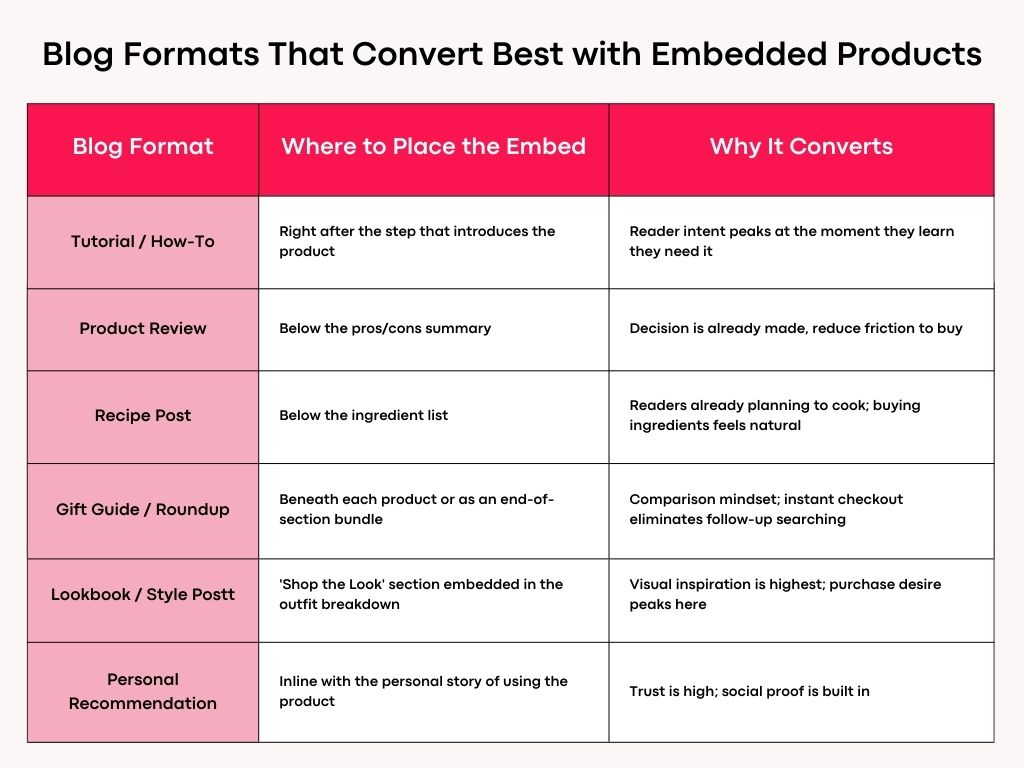
Blog Formats That Convert Best with Embedded Products
Not every post is an equal opportunity for embedded commerce. Some formats are naturally built for it.
The difference isn’t traffic. It’s intentional.
A tutorial or how-to guide converts best when the product appears right after the step that introduces it. The reader has just realized they need a specific tool. That is the peak moment. Placing the embed there turns curiosity into action.
A product review performs strongest when the embed sits directly below the pros and cons summary. By that point, the decision is almost made. Reducing friction at that exact moment increases completed purchases.
Gift guides and roundups work well with embeds placed beneath each featured item or as a curated bundle at the end of a section. Readers are already comparing options. Instant checkout removes the need for additional searching.
Recipe posts convert best when the product appears below the ingredient list. The reader is planning to cook. Buying the tool or ingredient feels like the next logical step.
Lookbooks and style posts benefit from a “Shop the Look” section embedded within the outfit breakdown. Visual inspiration is highest here. Purchase desire peaks alongside imagination.
Personal recommendation posts convert well when the product appears inline within the story of using it. Trust is already built. The buying suggestion feels authentic.
The principles are simple.
- Embed where reader intent peaks, not where empty space exists: The best placement is the exact moment a reader realizes they need the product. When intent is high, friction feels low. If you wait until the bottom of the page, that urgency is already fading.
- One contextual embed outperforms multiple generic placements: Relevance beats volume. A single, well-placed product tied directly to the topic will convert better than multiple scattered embeds that feel promotional or disconnected from the narrative.
- The component should feel native to the content flow, not like a forgotten sidebar: When a product component looks like it belongs inside the article, readers treat it as part of the recommendation. If it’s pushed into a sidebar or hidden at the footer, it feels like an ad instead of a natural next step.
A Concrete Example: From Blog Post to On-Page Sale
Imagine a food blogger publishing an article titled “My 5-Step Morning Coffee Ritual.”
Traditionally, she would link to Amazon for the grinder, the beans, and the digital scale. Three separate links, three separate tabs, and three separate chances for the reader to disappear.
Now, picture the embedded version.
A specialty coffee brand using Shopify creates a “Morning Coffee Kit” bundle inside EmbedUp. The bundle includes a grinder, single-origin beans, and a precision scale. As part of their collaboration, the brand shares the embed code with the blogger.
She places it right after Step 2: Grind Fresh. A clean product component appears: images, pricing with a “Buy the Full Kit” button.
The reader is already thinking about upgrading their ritual. They click and check out without leaving the blog. The blogger sees her commission tracked. The brand sees the sale attributed to that exact post via UTM data.
Old way: three affiliate links and three drop-off points.
New way: one embedded bundle, one seamless journey, one completed sale.
How to Monetize a Blog with Products: A Shopify Guide
Turning your blog into a revenue channel is simpler than most creators expect. The setup depends on whether you own a store or collaborate with brands.
Path A: You Have a Shopify Store
Start by installing EmbedUp from the Shopify App Store. There’s a free plan available, so you can test before committing.
Inside the app, create a product component. Choose individual products, a collection, or a curated bundle. Customize the layout, button style, and checkout behavior. You can let customers buy a single item or purchase the full bundle in one click.
Once configured, copy the embed code and paste it into your blog post. It works on WordPress, Ghost, Webflow, Wix, Squarespace, or any platform that accepts HTML blocks.
Each embedded component stays synced with your Shopify store in real time. If you update pricing, inventory, or variants, the changes reflect automatically inside your blog.
For a full WordPress walkthrough, see our full guide in how to embed Shopify products on a WordPress.
Path B: You Don’t Have a Shopify Store
If you work with brands, the merchant handles the setup.
They generate the embed component and share the code with you. You paste it into your post. No Shopify account required on your side.
Sales are tracked automatically through UTM parameters tied to your component. Your commission is attributed to your embed. Ask the brand to share their analytics summary so you can monitor performance and strengthen future negotiations.
Quick Checklist Before Going Live
- Component loads cleanly and matches your design
- Products, prices, and variants display correctly
- “Buy Now” or “Add to Cart” opens Shopify checkout properly
- UTM tracking is active and attribution is confirmed
- Embed is placed where reader intent peaks, not just at the end of the post
Conclusion
Bloggers have always been powerful at one thing: building trust.
You introduce ideas, recommend products and shape buying decisions long before a checkout happens. The missing piece was never “influence”. It was ownership of the purchase moment.
For years, monetization meant sending readers somewhere else and hoping they completed the journey. Embedded commerce changes that. The discovery and the checkout now live in the same place.
You don’t need a new platform. You don’t need to rebuild your content strategy.
You simply upgrade it.
Tools like EmbedUp make that shift possible by showing you exactly how to monetize a blog with products, turning your existing posts into seamless buying experiences without breaking the trust you worked so hard to build.
How to Monetize A Blog With Products: FAQ
Do I need a Shopify account to embed products on my blog?
No. If you’re collaborating with a Shopify merchant, they generate the embed code and share it with you. You simply paste the code into your post. You only need a Shopify account if you are the store owner creating the product components yourself.
How does commission tracking work if I’m a blogger (not the store owner)?
Tracking is handled through UTM parameters or component-level attribution tied to your embed. When a reader purchases through the embedded product, the sale is recorded and attributed to your specific post, allowing the merchant to calculate your commission accurately.
Can I embed products on any blogging platform, or just WordPress?
You can embed products on any platform that supports HTML blocks using EmbedUp. That includes WordPress, Ghost, Webflow, Wix, Squarespace, and most custom-built websites.
What’s the difference between this and a regular affiliate link?
A regular affiliate link redirects readers to another site, increasing drop-offs. An embedded product keeps the browsing and checkout experience inside your content, reducing friction and improving conversion rates.