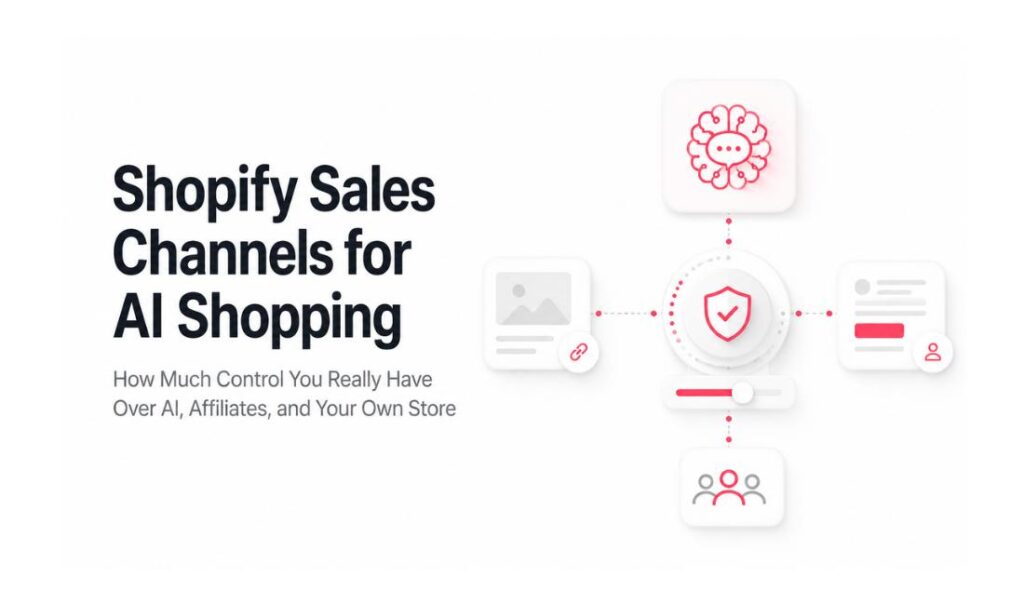
Shopify sales channels for AI shopping can now put your products in front of shoppers in three different ways, but merchants do not have the same level of control over each one. In your own store, you control the layout, messaging, product presentation, and buying experience.
Agentic storefronts work differently. AI tools such as ChatGPT, Microsoft Copilot, Google AI Mode, and Gemini can discover and recommend Shopify products through Shopify Catalog or connected sales channels. Merchants can manage their product data and some channel settings, but they cannot control which products an AI platform selects, how recommendations are worded, or which competitors appear alongside them. Affiliate and content embeds sit at the other end of the spectrum: a product only appears in a review, tutorial, comparison article, or partner post when a merchant or publisher deliberately places it there.
These are not competing channels where you need to choose only one. They are separate discovery surfaces that can work at the same time, each with different strengths, limitations, and levels of merchant control.
In this blog, you will learn how each surface works, what you can and cannot manage, and where your time and effort are most likely to make a difference.
Table of Contents
Where Your Products Actually Show Up Now
There are three places a shopper can run into your products without visiting your homepage:
- Your own store,
- An AI shopping agent, or
- Affiliate websites.
Shopify sales channels for AI shopping now cover the middle one largely automatically, through agentic storefronts, which draw on Shopify Catalog, a system that structures your product data so tools like ChatGPT and Microsoft Copilot can read it and recommend your products in conversation. The third surface, a blogger’s review, a comparison article, a partner’s shoppable post, works on a completely different mechanism. Nothing appears there unless someone puts it there on purpose.
That distinction matters more than most coverage of Shopify’s AI push admits. Shopify Sales Channels for AI Shopping aren’t competing options where you weigh one against the other and pick a lane. One runs largely in the background whether you engage with it or not. The other is deliberate, every single placement, and doesn’t activate itself.
Shopify Sales Channels for AI Shopping and What They Actually Do
AI shopping setup is not powered by one universal sales channel. Instead, Shopify agentic commerce relies on different systems to deliver product data to different platforms, and merchants have different levels of control over each one. Understanding those differences helps you manage product visibility without assuming that a single setting controls every AI surface.
- Agentic storefronts are active by default for eligible Shopify stores. Shopify’s agentic storefront overview explains how products can appear in AI shopping experiences. Shopify Catalog supports these experiences by organizing product information, but Catalog itself is a product-data layer rather than a standalone sales channel.
- ChatGPT and Microsoft Copilot access eligible product data through Shopify Catalog. Catalog provides structured information such as product titles, descriptions, images, options, prices, and availability.
- Google AI Mode and Gemini use a separate setup. According to Shopify’s Google AI Mode and Gemini setup guide, merchants need the Google & YouTube sales channel installed, with automatic product and shipping-information syncing activated. These features also remain in early access for some stores.
- Merchants have partial control over third-party AI channel access. Shopify’s agentic storefront management settings let merchants turn off “Allow Shopify to manage for me” and deactivate Shopify Catalog access for individual third-party agentic storefronts. However, merchants cannot opt out of Shopify Catalog itself.
- Disabling one AI channel does not disable the others. ChatGPT, Microsoft Copilot, Google’s AI surfaces, Meta, and Shop use different settings or product-data connections, so merchants may need to manage them separately.
- Removing Catalog access does not guarantee that a product disappears completely. Public product pages may still be discovered through web crawling, search-engine indexing, or external product feeds.
- Products can be removed from Catalog and search discovery, but there are tradeoffs. Using Unlisted status or the seo.hidden metafield may also reduce visibility in Google Search, Shop, storefront search, sitemaps, collections, or recommendations.
- Changes may not take effect immediately. For example, deactivating ChatGPT access can take up to seven days before Shopify stops sharing product data through that connection.
- Merchants control their product data, but not the final AI response. Each AI platform decides which products to recommend, how to rank them, what alternatives to compare them with, and how the recommendation is presented.
Affiliate Marketing Shopify: Slower to Build, but Deliberately Yours
Affiliate and content placements do not happen automatically. A product appears in a blogger’s buying guide, comparison article, or partner post because someone deliberately created that opportunity. The merchant may have contacted the publisher, joined an affiliate program, or produced the content themselves.
There is no background syndication and no Shopify setting that quietly places products across external websites. Every placement requires a decision, a relationship, or a piece of content. Among Shopify Sales Channels for AI Shopping, this is the surface that depends most on deliberate placement.
That makes this channel slower to build than AI-driven product discovery. Merchants earn visibility one placement at a time rather than being included automatically. In return, they gain more influence over:
- Where the product appears, such as a specific review, tutorial, or buying guide.
- What context surrounds it, including the problem being discussed and the audience reading it.
- Which products are promoted, rather than leaving the choice entirely to an AI platform.
That does not mean merchants have complete control. On a third-party website, control is shared with the publisher. The publisher still decides how the page is written, how the product is presented, whether the placement remains live, and where it appears on the page. The merchant’s control is therefore deliberate and negotiated, not absolute.
Where EmbedUp Fits
This is the surface EmbedUp is designed for. It does not replace Shopify Catalog or AI shopping channels. Instead, it helps merchants make their deliberately earned content placements more useful.
For shoppable blog posts Shopify merchants publish or place on partner websites, EmbedUp makes it possible to add a live product card directly inside a review, tutorial, affiliate article, or partner page. That card can show:
- Current product information
- Live pricing and availability
- Product options or variants
- A direct buying or checkout path
This creates a stronger experience than using a static screenshot or a basic link that sends readers away from the content they are already engaging with.
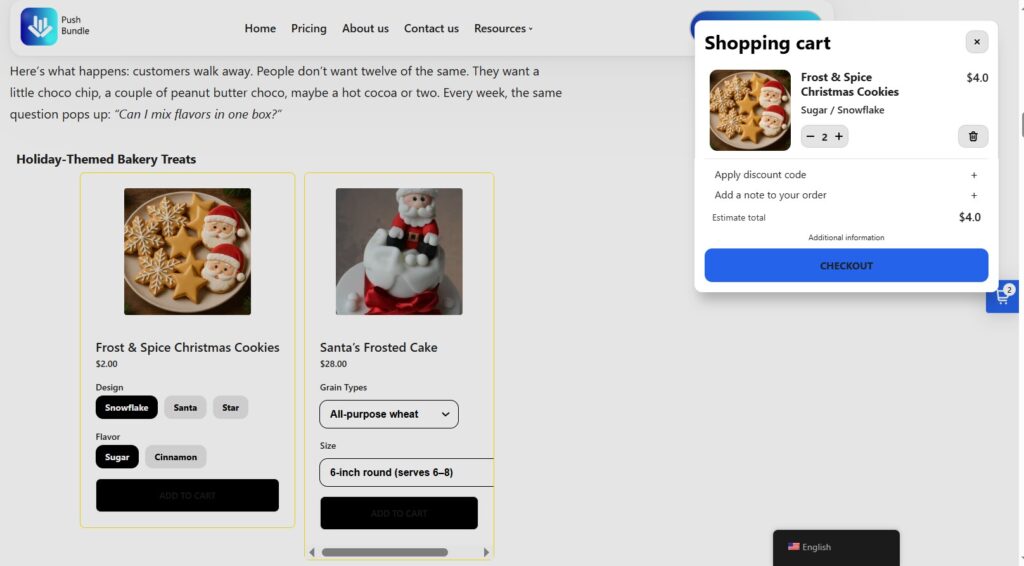
The distinction is important: Shopify Catalog supplies structured product data to supported AI platforms, while affiliate embeds let merchants intentionally place products within specific content. The AI platform controls which products it recommends and how it presents them. With an embed, the merchant has a direct role in choosing the product, the page, and the surrounding context, even though the publisher still controls the final article.
Consider a merchant selling trail running shoes. Shopify Catalog may make one of their products available when a shopper asks an AI assistant for “waterproof trail runners under $150.” However, the merchant cannot control whether the product is selected, how the recommendation is worded, or which competing products appear beside it.
Now compare that with the same shoe appearing in an outdoor publisher’s “Best Trail Running Shoes We Tested This Year” article. A live product card can sit directly beside the reviewer’s notes about grip, comfort, and break-in time. The merchant helped earn the placement and shape the buying context, even though the publisher retains final control over the page.
Both surfaces can generate sales. The difference is that affiliate content is built with the merchant involved in the placement.
Why Affiliate Content Still Matters Even as AI Discovery Grows
There is a reasonable question beneath all of this: Do merchants still need affiliates now that Shopify Catalog is handling more product discovery automatically?
The answer is yes, and not simply because “content still matters.”
Yotpo, an ecommerce reviews and retention platform, argues that some AI shopping tools may not evaluate a brand’s own claims in isolation. They may compare what a store says about itself with information found across:
- Third-party websites
- Publisher blogs
- Reddit discussions
- Forums
- Reviews and comparison content
Under this argument, a brand with little or no presence across external sources may appear less established or less verified than one that is regularly discussed elsewhere.
However, this should not be treated as a confirmed industry-wide rule. Yotpo is a vendor making a case connected to its own visibility tools, not an independent source proving that every AI platform evaluates brands in the same way. The claim is better understood as an informed argument rather than settled fact.
Still, the underlying possibility is reasonable: the same off-site content that helps a merchant earn a human reader’s trust may also influence how some AI discovery systems assess that merchant’s credibility.
It is equally important to be clear about what this does not mean:
- An EmbedUp product card does not automatically become part of Shopify Catalog.
- It does not train an AI model.
- It does not guarantee that a product will appear in an AI recommendation.
What the available evidence does suggest is that third-party reviews, comparison posts, publisher coverage, and forum mentions are not necessarily separate from AI visibility. They may be adjacent to it on platforms that cross-reference external sources when evaluating brands and products.
How AI Shopping Agents Find Shopify Products, and How Much Control Merchants Have
A lot of AI shopping coverage frames “control” as a single dial, either you’re visible or you’re not. That’s not how it actually works for a Shopify merchant running all three surfaces at once. Control varies by surface, and by how much effort a merchant is willing to put into managing each one. Laid out side by side, the control picture looks like this:
- Your own store. Full control. You decide everything about layout, copy, and presentation, but the shopper has to already be there.
- AI shopping agents through agentic storefronts. Partial control. Active by default for eligible stores on the channels that use Shopify Catalog directly, Google AI Mode and Gemini require separate setup and remain early access, merchants can deactivate access per channel, but can’t opt out of Catalog itself, can’t control final AI rankings or wording, and some discovery can persist regardless.
- Affiliate and content embeds. Deliberate control, shared with the publisher. Nothing appears without a deliberate placement, but building reach here takes real relationship and content work, and the final say on a given page still belongs to whoever owns it.
In short, Shopify products can be found through Shopify Catalog-powered channels like ChatGPT and Microsoft Copilot, through the Google & YouTube sales channel for Google AI Mode and Gemini, through web crawling, indexing, and other external listing methods, and possibly through third-party mentions and reviews that some AI discovery systems may weigh, according to platforms like Yotpo, though that last mechanism varies by platform and isn’t confirmed universally.
What This Means for Where You Put Your Effort
Shopify Sales Channels for AI Shopping are not a choice between affiliate marketing and AI shopping agents competing for the same budget. Shopify Catalog is already running for eligible stores whether a merchant actively manages it or not, so the real decision is not whether to use it, but how closely to manage the settings that do exist. The more deliberate choice is whether to keep investing in reviews, tutorials, and partner content that a merchant has a real hand in shaping, and whether those placements use live product cards that work rather than static links that eventually go stale.
Clean up the surface you don’t fully control first. Vague titles and thin descriptions hurt a listing whether an AI agent is parsing it or a human is skimming it, so this is the lower-effort, higher-leverage fix. Check what Shopify Catalog is actually syndicating for your top products before assuming it’s accurate.
Then keep building the surface you control most. A merchant who’s been treating affiliate content as optional now that AI discovery exists has good reason to reconsider that, not because affiliate content directly feeds Shopify Catalog, but because it may feed the same trust signal some AI discovery systems are already weighing.
Don’t confuse activity on one surface for progress on the other, but don’t dismiss either. Shopify is explicit that well-optimized, complete product data can help merchants reach more customers through better discovery and ranking on AI platforms, so this isn’t pure maintenance with no upside. It’s a lower ceiling than the affiliate and content surface, where deliberate, compounding effort still has the most room to work, and where a merchant still can’t control final AI rankings or wording either way.
Shopify Sales Channels for AI Shopping: FAQ
Can I opt out of Shopify Agentic Storefronts?
Only partially. You can deactivate Shopify Catalog access for specific AI channels in the Agentic section of Shopify admin, but Shopify is explicit that you can’t opt out of Shopify Catalog itself. Removing a product from Catalog and search discovery entirely, using Unlisted status or the seo.hidden metafield, also reduces its visibility in Google, Shop, and your storefront search.
Does Shopify Catalog use my product images and descriptions without my permission?
Shopify Catalog syndicates whatever product data you’ve published, titles, images, descriptions, pricing, to the AI channels that have access to it, as part of agentic storefronts being active by default. Merchants with specific vendor contracts or licensing concerns should review their agreements directly, since that’s a legal question outside what Shopify’s documentation addresses.
Do I need to do anything for AI channels to find my products?
For the channels that use Shopify Catalog directly, ChatGPT and Microsoft Copilot, eligible products are included automatically with no setup required. Google AI Mode and Gemini work differently and require the Google & YouTube sales channel installed with product and shipping syncing activated, and that channel is still in early access for some stores.
Will AI shopping replace affiliate marketing for Shopify stores?
AI shopping isn’t replacing affiliate marketing, since the two run on entirely different mechanisms. AI shopping through Shopify Catalog happens largely automatically for supported channels, while affiliate and content placements only happen when a merchant or partner deliberately creates them, and off-site content presence may still feed AI trust signals on some platforms.
What’s the difference between Shopify Catalog and an affiliate product embed?
Shopify Catalog is the structured product-data layer that supports AI channels drawn on automatically. An affiliate embed is a merchant or partner deliberately placing a live product card inside specific third-party content, like a review or tutorial, that a human reader is already engaging with.
The Bottom Line
Shopify sales channels for AI shopping and affiliate content aren’t rival strategies fighting for the same budget. Shopify Catalog is an automated background system with partial merchant control: merchants manage their product data, channel access, and enrollment settings, but can’t control final AI rankings, wording, or recommendations, and can’t opt out of Catalog itself. Affiliate and content embedding is the opposite: slower to build, and never entirely unilateral on someone else’s page, but the one surface where a merchant has real say in exactly where a product shows up and to whom. The merchants doing well on both fronts aren’t picking a favorite. They’re keeping their product data clean for the surface they don’t fully control, and putting real effort into the placements on the surface they do.

Syeda Rehnoma Tanzom
This article was reviewed by the EmbedUp Technical Support Team, who regularly helps Shopify merchants test embedded product displays, component setup, add-to-cart behavior, product syncing, and checkout flow issues.