Shoppable Blog Posts for AI Search: What Happens After ChatGPT Cites You
 Syeda Rehnoma Tanzom12 min read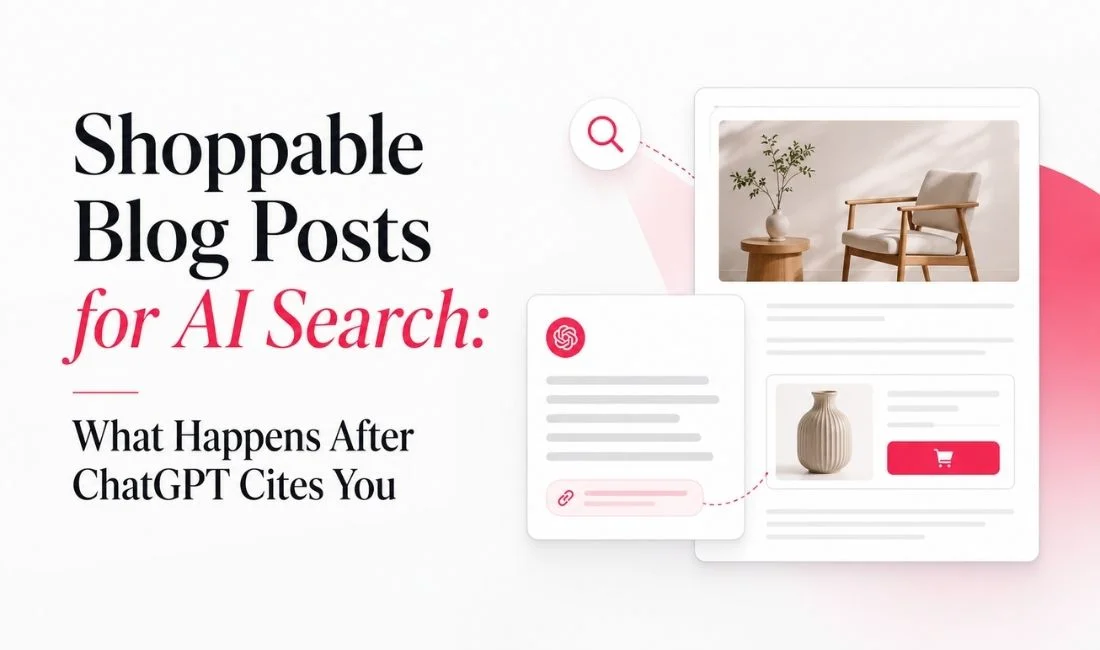
On this page
- How Shoppable Blog Posts Get Used in AI Search Answers
- Getting Cited Doesn't Always Mean Getting Clicked
- What Actually Gets a Blog Post Cited?
- How Does ChatGPT Decide Which Blog to Cite?
- What to Put on the Page So the Click Turns Into a Sale
- Selling Your Own Product
- Promoting a Partner's Product
- Running It as a Straight Affiliate
- Final Words
- FAQ
AI answer engines can now cite blog posts directly through ordinary web search and crawling, separately from Shopify’s product-data systems.
That means a useful article can appear in ChatGPT or Google AI answers, but getting cited does not guarantee a sale. If someone clicks through and the product is buried on another page, the reader has to search again, find the right item, and restart the buying process.
For merchants, bloggers, and affiliates, AI visibility only becomes commercially useful when the landing page is ready for the traffic it receives. A cited post that explains the product well but gives readers no easy way to buy can lose high-intent visitors at the final step.
This guide explains what makes a blog post more likely to earn an AI citation, how AI referral traffic works, and what to add to a post so readers can move from AI discovery to purchase without hunting for the product page.
TL;DR
Blog posts can surface in AI answers through ordinary web search and crawling, separately from Shopify's structured product-discovery systems.
Being crawlable and indexed makes a page eligible, but relevance, authority, usefulness, and how clearly the page answers the question influence whether it actually earns an AI citation.
Citation does not guarantee traffic. A user may get enough information from the AI answer without clicking.
AI referral traffic is becoming easier to measure: OpenAI now adds "utm_source=chatgpt.com" to ChatGPT referral URLs, although attribution still varies across AI platforms.
Once someone lands, embedding the relevant Shopify product inside the article with EmbedUp can shorten the path from recommendation to purchase.
How Shoppable Blog Posts Get Used in AI Search Answers
For Shopify merchants, it helps to think about AI discovery as two overlapping pathways, rather than one universal pipeline.
One pathway is commerce data. Shopify Catalog, connected sales channels, and structured product information help AI shopping experiences understand what a merchant sells. Agentic storefront systems can then use details such as pricing, availability, variants, and other purchase-related information.
The other pathway is the ordinary web.
A tutorial, comparison, buying guide, review, recipe, industry explainer, or other blog post can be discovered because it exists as an indexable web page. Shopify's own enterprise guidance now makes this connection explicit: many AI systems retrieve content from web search indexes when generating answers, so traditional search visibility can directly contribute to AI visibility.
OpenAI provides similar guidance from the publisher side. Public websites can appear in ChatGPT Search, and publishers that want their content eligible for summaries and citations should allow OAI-SearchBot to access it. OpenAI also makes an important limitation clear: inclusion and placement are not guaranteed. ChatGPT Search uses multiple factors intended to surface relevant and reliable information.
Google’s documentation follows the same basic principle. A page must be indexed and eligible to appear in Google Search with a snippet before it can appear as a supporting link in AI Overviews or AI Mode. Google also says these AI features use Search systems to identify relevant supporting web pages, including through multiple related searches across topics and data sources.
This distinction matters because Shopify's current merchant guidance around AI optimization is still heavily product-focused. Its help documentation concentrates on product detail pages, product specifications, structured product data, and Shopify Knowledge Base, while Spring '26 Search Intelligence focuses on the AI queries where products rank or fail to convert.
Your blog has another job. It can become the explanatory, comparative, or educational source an AI answer uses before the shopper ever reaches a product recommendation.
Getting Cited Doesn't Always Mean Getting Clicked
An AI citation creates visibility. It does not automatically create a visit.
Sometimes an AI answer gives the user enough information to continue without opening any source. A brand or product may also be mentioned as part of a synthesized answer without the user deciding to inspect the supporting page.
That means there are really two conversion problems.
First, your post has to be useful enough to become part of the answer. Then, if the person clicks, the landing page has to turn that interest into something commercially useful.
Measuring the second part is also changing quickly.
Older AI-traffic analyses often warned that ChatGPT visits could disappear into Direct traffic because referral information was lost. That should no longer be treated as a universal current rule. OpenAI now says ChatGPT automatically includes utm_source=chatgpt.com in referral URLs, allowing publishers to identify those visits in tools such as Google Analytics.
The wider attribution problem has not disappeared, though.
Shopify notes that some AI-assisted discovery, particularly Google AI Overviews, can appear as organic search rather than a separate AI referral in standard analytics. Shopify therefore says the real amount of AI-mediated commerce is probably higher than dedicated AI-referral numbers alone suggest.
Google has also begun rolling out dedicated generative-AI visibility reporting in Search Console, although the feature was initially limited to a subset of websites.
So when asking how to track AI traffic to a blog, do not rely on one channel label. Look at identifiable ChatGPT referrals, Google Search visibility, landing-page behavior, and, where possible, the revenue generated by the exact content placement.
What Actually Gets a Blog Post Cited?
There is no published checklist that guarantees ChatGPT will cite a particular article.
OpenAI says its search ranking considers multiple factors related to relevance and reliability, while Google tells publishers to focus on helpful, reliable, people-first content and the same technical foundations used for traditional search.
That gives us principles, not a secret formula.
Independent research can tell us more about patterns, but those patterns should be treated as evidence rather than platform rules.
How Does ChatGPT Decide Which Blog to Cite?
A useful starting point is whether the page gives the system a clear answer to the question it is trying to resolve.
Search Engine Land analyzed content across 15 domains and nearly two million sessions to identify patterns associated with ChatGPT citations. Among the cited blog posts studied, 72.4% contained an identifiable “answer capsule”, a concise, self-contained response to the main question, while 52.2% featured original data or brand-owned insight.
That does not mean adding a 25-word paragraph will make ChatGPT cite you. It means clearly answerable passages were strongly associated with citations in that particular dataset.
For an existing article, audit the page from that perspective.
If the H2 asks "What is X?", does the next paragraph actually answer it? If someone extracted two sentences from the section without the rest of the article, would they still make sense? Are factual claims supported? Does the article contribute something more useful than ten pages repeating the same definition?
For new posts, write around real questions rather than decorating a keyword with 1,500 words.
Give important questions direct answers early. Use descriptive headings. Support statistics with identifiable sources. Add firsthand observations, examples, original testing, screenshots, comparisons, or data when you genuinely have them. Keep important information in crawlable page content rather than hiding the entire answer inside graphics or interactive elements.
And do not abandon SEO in the process.
Google says there are no special technical requirements for appearing in its AI features beyond being eligible for Search, while Shopify explicitly advises merchants to keep investing in organic search because search ranking can feed AI retrieval.
The practical answer to "can AI recommend my blog post?" is therefore yes, but you cannot order the citation. You can make the page discoverable, relevant, trustworthy, specific, and easy to extract an accurate answer from. The AI platform still makes the final selection.
What to Put on the Page So the Click Turns Into a Sale
Now we reach the part where AI-visibility advice usually stops before.
Suppose somebody asks ChatGPT for advice on choosing a standing desk for a small apartment. The answer cites your comparison article. The reader opens it because your explanation sounds useful.
What happens next?
If your post says "We recommend Model X" and then gives the reader a text link, they still have to open another page, relocate the product, select the right option, and continue toward checkout.
A shoppable article can shorten that path.
Shopify itself supports the broader idea of placing purchase options inside content. Its 2026 Buy Button guidance specifically describes blog posts and content pages as places where embedded commerce can connect reading with buying without making a shopper search the store separately.
For merchants and publishers that need more control over these placements, EmbedUp is built around the same after-the-click problem. It lets Shopify products or collections appear inside blogs and external websites with live product information, variant selection, cart or checkout actions, and attribution for partner placements.

It does not make an article rank in ChatGPT. It makes the article more useful commercially if the citation produces a visit.
Selling Your Own Product
Imagine a cookware merchant publishes:
"Stainless Steel vs Carbon Steel Pans: Which Is Better for High-Heat Cooking?"
The article answers the comparison properly rather than turning into a disguised product description. An AI answer engine could potentially use that explanation when somebody asks the same question.
When the reader arrives, the merchant can place the relevant pan directly below the section where it is recommended.
Instead of "View this product in our store," the visitor can see the current product, price, available options, and purchase action while the recommendation is still in context.
This is the simplest version of embedding Shopify products in blog posts: discovery happens through the article, while buying becomes part of the article.
Promoting a Partner's Product
The same model works when the publisher and merchant are different businesses.
Imagine a cycling blogger publishes an in-depth guide to choosing a waterproof commuter backpack. One of the products comes from a Shopify brand the blogger works with.
The merchant can create a tracked EmbedUp component for that placement and share it with the publishing partner. EmbedUp supports affiliate and partner components, sales tracking, commissions, and product embeds on external websites.
If an AI answer later cites the blogger's guide, the visitor does not need to move from article to affiliate link to store search to product page. The recommended product can already be available where the explanation lives.
That gives the merchant another useful measurement layer too. AI analytics may tell you that ChatGPT sent traffic. Placement tracking can tell you whether that particular article actually generated carts or revenue.
Running It as a Straight Affiliate
The third case needs one important distinction.
A publisher cannot independently take any Shopify merchant's product and turn it into an EmbedUp affiliate component without the merchant participating. EmbedUp connects to the merchant's Shopify store, and its affiliate workflow allows the merchant to create or assign tracked components to affiliates.
So if you are a straight affiliate working only with a traditional tracked link, your first job remains producing useful content and earning the click.
If the merchant is willing to support a deeper content placement, the relationship can move from a link-only recommendation to an embedded, tracked buying experience. The affiliate still does not own the inventory or checkout. They simply make the product easier to buy from the content that created the demand.
These are useful shoppable blog post examples because the pattern stays the same across all three.
The AI answer creates discovery. The article creates confidence. The embedded product reduces the distance between that confidence and the purchase.
Final Words
Blog content and Shopify product data now have more than one route into AI-driven discovery.
Your product catalog helps shopping systems understand what you sell. Your articles can enter AI answers through the ordinary search and web-retrieval layer. Clear answers, useful original information, strong organic-search foundations, and accessible pages can improve your chances of being selected, but no optimization can guarantee an AI citation or a click.
That is the boundary worth remembering.
You cannot control whether ChatGPT chooses your article. You can control what the visitor finds if it does.
If the article already answered the question, built trust, and introduced the right product, making that product buyable inside the same experience is a logical next step rather than sending a high-intent reader off to find it again.
FAQ
Does Shopify Catalog need to be set up for my blog posts to show up in AI answers?
Why did ChatGPT mention my product but nobody clicked through to my post?
Can a partner or affiliate blog post get cited the same way as one about my own product?
How do I know if AI search is actually sending traffic to my blog?
Do my older posts need a rewrite, or does this only apply to new ones?
- shoppable blog posts for AI search
- AI citation
- AI answer engines
- embed Shopify products in blog posts
- AI referral traffic
- how does ChatGPT decide which blog to cite
- can AI recommend my blog post
- add a buy button to a blog post
Related articles
 Shopify Updates
Shopify Product Data Checklist: Fix AI Shopping & Embed Errors
A practical checklist to fix product data issues across Shopify Catalog, Google AI shopping, and product embeds. Find the right source of missing products, wrong prices, GTIN errors, or outdated embed settings.
12 min read
 Shopify Updates
Will AI Shopping Replace Shopify Content Commerce? What Spring '26 Means for Merchants
Shopify’s AI-powered shopping is changing how products get discovered, but that doesn’t mean merchants should overlook content commerce. This blog explores why shoppable content, blog placements, and affiliate partnerships still matter, and where merchants have the most control.
12 min read
 Shopify Updates
Shopify Catalog vs Affiliate Embeds: Why AI Product Discovery Doesn’t Replace Content Placement
When you put Shopify Catalog vs affiliate embeds side by side, the honest answer is…
12 min read