Blog monetization strategies have shifted more in the past two years than in the decade before. Many publishers are finding display ad revenue harder to rely on. Affiliate commissions are harder to track accurately. And the average blog reader has become far less patient with the experience of clicking a recommendation link, landing on an unfamiliar storefront, and being expected to start a purchase journey from scratch in a place that has none of the trust your article just spent ten minutes building.
According to Baymard Institute’s analysis of 50 independent studies, the average online cart abandonment rate sits at 70.22%. For affiliate-driven traffic that is already two or three clicks removed from the sale, that drop-off compounds at every step.
The shift that changes this is embedded commerce. Bloggers who run a Shopify store, or who partner with brands that do, can now place shoppable product widgets directly inside their articles. Readers browse the product, add it to the cart, and move toward checkout without being sent to a separate storefront.
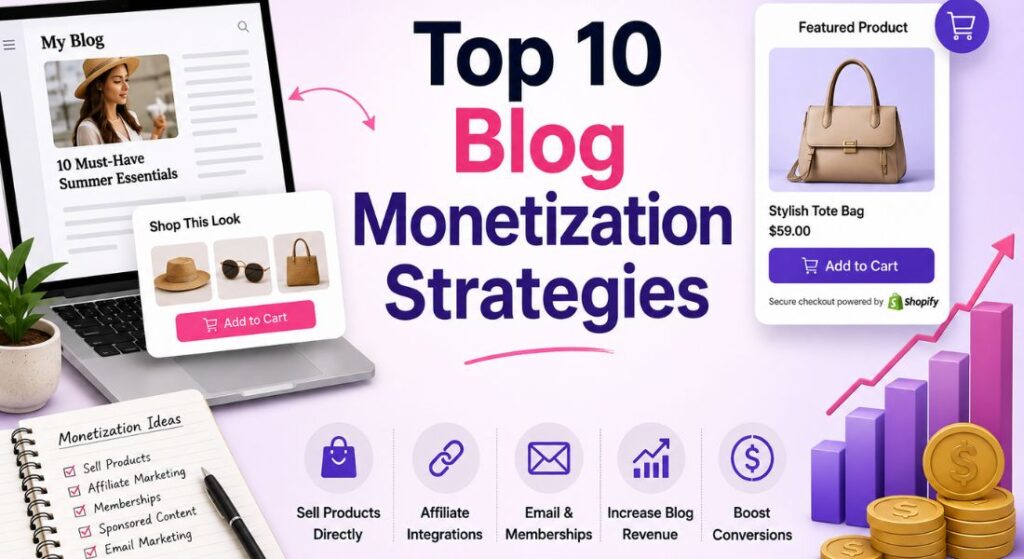
This guide covers ten practical blog monetization strategies for 2026, including:
- Selling products directly from blog posts
- Turning gift guides into shoppable pages
- Using embedded product widgets for sponsored content
- Combining email, memberships, ads, and embedded commerce
- Building a lower-friction buying flow for readers
- Blog monetization in 2026 works best when readers can buy without leaving the content.
- EmbedUp lets bloggers add shoppable Shopify product widgets directly inside blog posts.
- Gift guides, reviews, sponsored posts, and resource pages can become revenue-generating pages.
- Email, memberships, affiliate widgets, and embedded products can work together to increase income.
- Display ads still help, but embedded commerce adds a stronger monetization layer.
Table of Contents
Top 10 Blog Monetization Strategies in 2026
Strategy 1: Sell Products Directly from Blog Posts Without Redirecting Readers
This is the strategy most bloggers have skipped, not because it is difficult, but because, until recently, most did not know it was technically possible.
Embed products on a blog to sell directly means placing a shoppable product widget inside the actual body of your article, right at the point where a reader’s intent is highest. Not in a sidebar. Not in a footer. Right below the paragraph where you recommend the product.
A food blogger writing about meal prep can embed her protein powder directly under the section where she describes using it. A fitness blogger writing a recovery guide can place his foam roller right after the paragraph where he explains why he needs it.
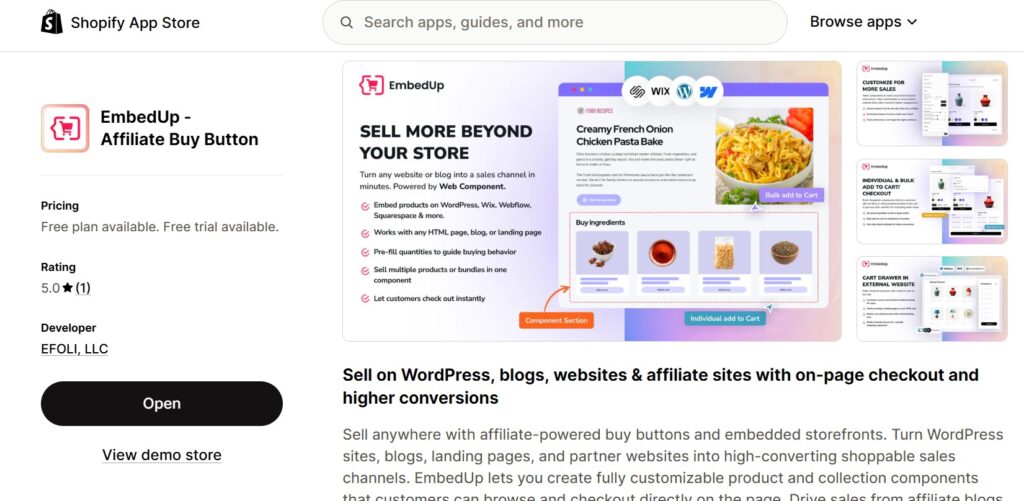
EmbedUp makes this possible for Shopify merchants. You select the product or collection, customize the widget layout to match your blog’s design, copy the embed code, and paste it into your WordPress, Webflow, or Squarespace post. The widget stays synced with your Shopify inventory, so pricing and availability update automatically without you touching anything.
This works especially well for:
- Product reviews
- Gift guides
- Recipe posts
- Fitness tutorials
- Skincare routines
- Resource pages and “shop my picks” pages
This is how to sell products from a WordPress blog in a way that keeps the purchase flow inside your content. Readers can browse products and move to checkout with far fewer steps than a standard redirect to a separate storefront.
According to Shopify’s Buy Button documentation, merchants can embed product listings, a cart, and checkout into any external website page, which is exactly the foundation EmbedUp builds on.
A simple guide on embedding Shopify products on any website covers every step from product selection to going live on your blog.
Strategy 2: Use an Affiliate Buy Button That Keeps Readers on Your Page
Standard affiliate links are exit doors. Every click sends your reader to someone else’s website, someone else’s checkout, and a completely different brand experience. Your conversion window shrinks the moment they leave your page.
An affiliate buy button for blog posts works differently. A brand you partner with provides an embeddable product widget instead of a text link. You paste it into your article. The product appears inside your content with a working add-to-cart button. The sale is tracked through UTM parameters tied to your specific embed, so attribution is clean and reliable on both sides.
The advantage is a simpler path from reading to purchasing. Embedded components reduce the number of steps between a reader’s moment of interest and the checkout, compared to the standard redirect through a separate storefront. The brand gets cleaner, trackable attribution instead of relying on last-click data scattered across multiple tabs and sessions.
Fewer steps between reading and buying means fewer opportunities for a reader to get distracted, compare prices elsewhere, or simply close the tab before completing the purchase.
Strategy 3: Turn Gift Guides and “Best Of” Lists Into Shoppable Pages
Gift guides and roundup posts are among the highest-traffic content types for any niche blogger. They rank well for seasonal and product-specific searches. They attract readers with real buying intent. And they are traditionally weak at converting because every recommendation sends the reader somewhere else to actually buy it.
Shoppable blog content strategy changes this. Each product recommendation in your guide gets an embedded widget. A reader browsing your “Best Home Office Gifts Under $100” post can add items to their cart without leaving the article. Discovery and purchase happen in the same reading session.
For example, a shoppable gift guide can include:
- One product embedded under each recommendation
- A short reason why the product fits the reader
- Variant options when needed
- Live pricing and inventory from Shopify
- A direct add-to-cart path from the article
The long-term value here is real. An embedded gift guide published in early 2026 keeps generating revenue for months because the product widgets stay synced with Shopify inventory. Prices update automatically. Sold-out variants disappear without any manual editing from you. You publish once, and it keeps working.
Strategy 4: Turn Sponsored Posts Into Performance-Based Revenue
Most sponsored blog posts still work on a flat fee model in 2026. The brand pays. You write. You link. The brand receives impressions and maybe some clicks. Neither side knows with any certainty how many purchases that content actually drove.
Embedded product widgets change this conversation. Instead of placing a text link, you embed the brand’s Shopify product directly into the sponsored section of your post. The brand can now see click rates, add-to-cart behavior, and completed purchases traced back to your specific embed through UTM tracking.
When you can show a brand that your embedded post drove a measurable number of completed checkouts, the conversation shifts from selling exposure to selling results. Performance-based arrangements become possible. A flat fee plus a per-sale commission tracked through the embed is a deal structure that genuinely benefits both sides.
That is how to make money from a blog in 2026 at a rate that goes well beyond a flat sponsored placement fee.
Strategy 5: Build an Email List and Send It Back to Shoppable Content
Email remains one of the highest-converting channels in eCommerce. A list of 5,000 genuinely engaged readers can outperform 50,000 monthly pageviews when the destination is set up properly to sell.
The combination that works in 2026 is direct. You publish a blog post with embedded products. You send an email that links back to that post with a clear reason to read it. The subscriber arrives at familiar content they already trust, finds the product embedded exactly where it becomes relevant, and moves toward checkout without being redirected somewhere unfamiliar.
Best ways to monetize a content blog 2026 consistently include email as a traffic amplifier, but the destination matters as much as the list size. Sending subscribers to a post with no embedded purchase option leaves a real conversion opportunity on the table.
Strategy 6: Sell Digital Products Alongside Physical Ones
Not every blogger sells physical goods. A business coach, a recipe developer, or a design educator may sell digital products like templates, ebooks, courses, or presets. Those products deserve the same frictionless embedded experience as anything physical.
Shopify handles digital products, and EmbedUp embeds them the same way as physical items. A cooking blogger can embed a “30 Meal Prep Recipes” PDF download directly inside a meal planning post. The reader purchases the download without being redirected to a separate store page.
Pairing a digital product embed with a physical product embed in the same post is one of the more underused blog monetization ideas beyond ads. A skincare blogger could embed a skincare routine ebook alongside three individual product widgets in a single post, covering different price points for readers at different stages of decision-making.
Strategy 7: Create a Shoppable Resources or Shop My Picks Page
Most bloggers have a resources page or a shop page. Most of those pages are a wall of text links. A reader must click each one individually, visit each separate store, and piece together a purchase entirely on their own.
Sell products directly from blog without redirecting means your shop page can function like an actual store. Every product on your picks page gets an embedded widget. A reader can browse multiple products and add several to a single cart without leaving your domain at all.
A stronger shoppable resources page can include:
- Favorite tools
- Recommended products
- Digital downloads
- Partner products
- Seasonal picks
- Bundles or curated kits
Turn your blog into an online store without rebuilding anything or migrating your content to Shopify. That is exactly what an embedded picks page does for a blogger who wants a real commerce experience inside their existing CMS in 2026.
Strategy 8: Launch a Curated Bundle Campaign With a Brand Partner
Instead of embedding individual products from a brand partner, you can work together to build a curated kit that is sold through your blog as a complete campaign. A fitness blogger partners with a supplement brand, and they create a “30-Day Reset Kit” with four products. That kit is embedded inside a post written specifically around the challenge the kit is designed to support.
This is how to embed Shopify products on your blog as a campaign asset rather than just a product listing. The post provides the narrative and builds the context. The embedded kit gives readers a clear path to purchase. The brand gets a complete campaign placement rather than a simple banner link.
Bundled embeds also increase the average order value for the brand. Instead of one product selling, four products sell together, through a blogger whose audience already trusts them.
Strategy 9: Use Memberships for Recurring Revenue
Display ad revenue is passive but low, and getting harder to rely on. Affiliate commissions are unpredictable month to month. One blog monetization category that creates genuine income stability is recurring membership revenue.
A membership model naturally combines with embedded commerce. Members get early access to shoppable gift guides before they are published publicly. Exclusive discount codes from brand partners appear embedded directly inside member-only posts. Curated product recommendations that never appear in free content reward paying members with real additional value.
Blog monetization ideas beyond ads work best when different revenue streams stack on top of each other. A membership that includes early access to embedded product drops from brand partners creates both reader value and reliable recurring revenue simultaneously.
Strategy 10: Use Display Ads as a Floor, Not a Ceiling
Display ads are not finished, but they should be the minimum baseline of your monetization strategy in 2026, not the primary income stream.
According to GWI data reported by Backlinko, approximately 29.5% of global internet users actively use ad blockers as of Q2 2025. That means roughly three in ten of your readers may never see your display ads at all. Add that to variable CPM rates across most ad networks, and you have a revenue source that works as a baseline but cannot scale reliably on its own for every niche.
A stronger monetization mix usually includes more than one layer:
- Display ads for baseline revenue
- Embedded products for purchase-ready readers
- Email traffic for repeat visits
- Sponsored embeds for brand partnerships
- Memberships for recurring income
The stronger approach is running display ads as a revenue floor while building embedded product revenue on top. A post that earns $4 RPM from ads and also drives $300 in embedded product sales in the same month is performing on two separate layers at once.
Ads reward traffic volume. Embedded commerce rewards content relevance and reader trust. You want both working together, but you need to know which one has more growth potential for your specific audience and niche.
Final Thoughts
Blog monetization strategies in 2026 favor bloggers who close the gap between their content and the point of purchase. Every redirect you ask a reader to follow is a chance for them to get distracted, open a comparison tab, or simply forget why they clicked in the first place. The bloggers earning the most from their content are not always the ones with the most traffic. They are the ones who have removed the friction between a reader’s moment of interest and their moment of purchase.
If you run a Shopify store alongside your blog, or if you work with brands that do, EmbedUp gives you a direct path to that lower-friction selling experience. No store rebuild. No complex integration. You paste a code, and your blog becomes shoppable. Start with your single highest-traffic post, embed one product that is genuinely relevant to what the reader is already there to read, and compare the buying flow with a standard affiliate link that sends readers away from your page.
FAQs
What are the best blog monetization strategies in 2026?
The strongest blog monetization strategies in 2026 combine embedded product sales, email-driven traffic to shoppable content, sponsored embedded campaigns with performance tracking, and recurring membership revenue. Display ads work well as a baseline but should not be the sole revenue model for any blogger with a defined niche and an engaged audience.
How can I sell products directly from my blog posts?
You can sell products directly from blog posts by embedding a shoppable product widget inside the article itself. EmbedUp connects to your Shopify store and generates an embed code you paste into any WordPress, Webflow, or Squarespace post. Readers can browse products and move to checkout with far fewer steps than a standard redirect to a separate store.
How do I embed a Shopify product on my WordPress blog?
Install EmbedUp on your Shopify store. Select the product or collection you want to feature. Choose a display layout and customize it to match your blog design. Copy the generated embed code. In WordPress, paste the code into an HTML block inside the post at the exact point where the product is most relevant to what the reader is already reading. The widget stays synced with your Shopify inventory automatically.
What is better for blog monetization in 2026: ads, affiliates, or selling products?
For bloggers with a defined niche, a trusted audience, and relevant products to offer, selling through embedded commerce can outperform both display ads and standard affiliate links. Ads pay by views regardless of trust level. Standard affiliates pay a percentage only if the reader completes a purchase after being redirected elsewhere. Results depend on the niche, the product relevance, and how well the embed is placed within the content.