Affiliate Links vs Embedded Product Selling: Which Fits Each Partner?
 Syeda Rehnoma Tanzom20 min read
On this page
- What is the difference between affiliate links and embedded product selling?
- Affiliate links vs embedded product selling at a glance
- What happens between the click and the order
- How each method credits the partner, and what it misses
- When affiliate links are the better choice
- When embedded product selling is the better choice
- Which method fits each type of partner
- The Four-Question Placement Test
- Using both: a worked example
- What Shopify offers natively, and where an app fits
- Disclosure rules apply to both
- How to start: move your top partners first
- Limitations to know before you choose
- Conclusion
- FAQ
- Is embedded selling better than affiliate links?
- Do I still need affiliate links if I use embedded products?
- Is an affiliate link or a discount code better for tracking?
- Can I add an affiliate's tracking to a Shopify Buy Button?
- Do my partners need a Shopify account to embed my products?
- Do embedded product placements need an affiliate disclosure?
- What is a good affiliate link conversion rate?
- Does Shopify have a built-in affiliate program for merchants?
- What happens if a partner's website blocks the embed script?
Your best partner is a skincare blogger whose "best moisturizer for dry skin" guide sends you hundreds of clicks a month. Your affiliate dashboard shows a handful of sales from her. She's sure it's more, and both of you might be right.
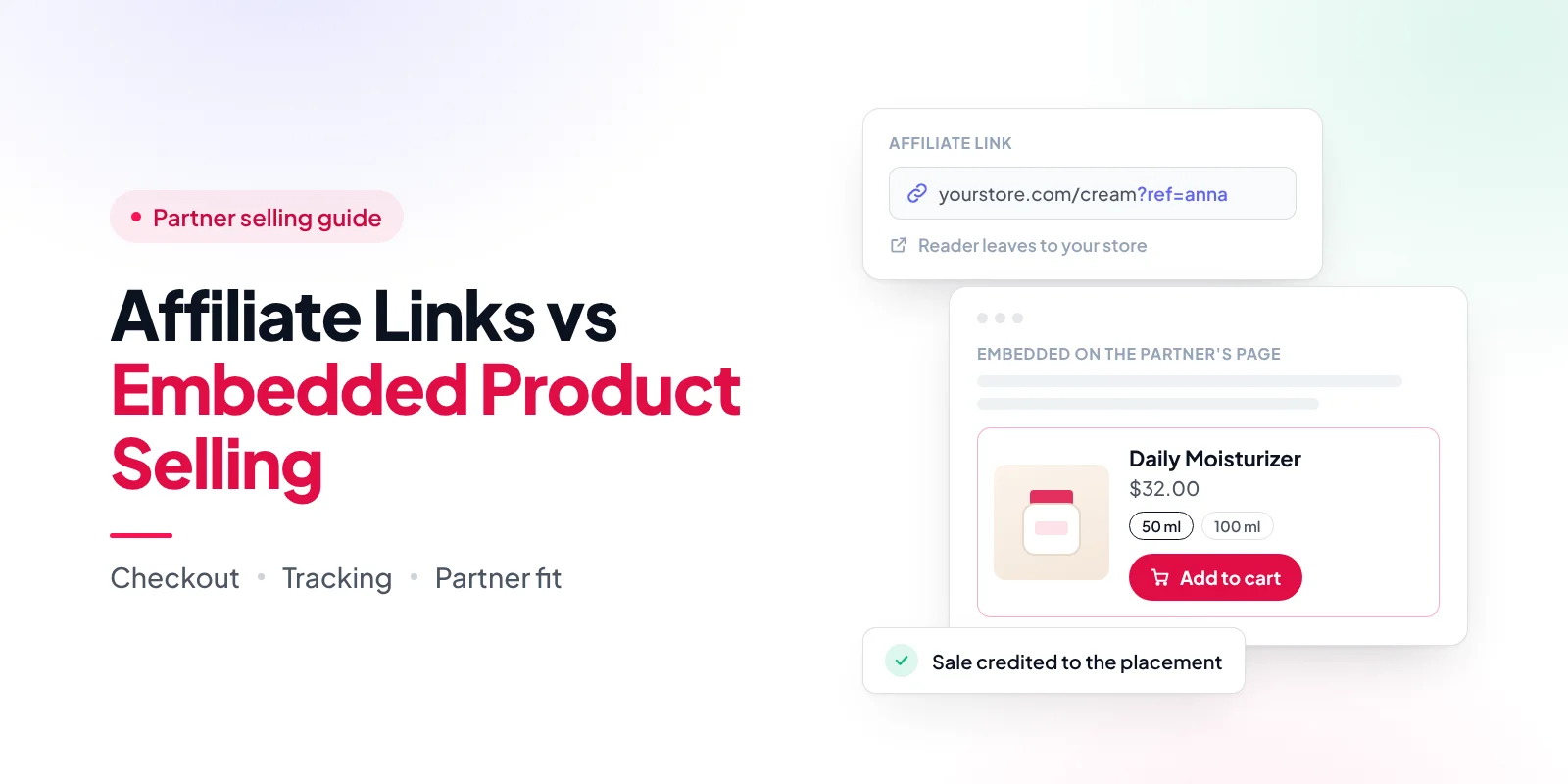
When it comes to affiliate links vs embedded product selling, that gap is the real problem. An affiliate link sends the reader away in the middle of a decision, to a store page where they have to find the right product and size again. The tracking cookie that's meant to credit your partner can disappear before they buy. Embedded selling keeps the product and the cart on the partner's page, but it needs a page that can run code and a partner who's willing to add it.
The method you choose for each partner affects how many readers finish buying and whether your partners trust the numbers you pay them on. Choose badly, and you lose buyers, partners, or both.
Neither method wins everywhere. Affiliate links are better for reach and quick setup, and embeds are better on pages where readers make up their minds. This guide compares the two step by step, shows what each one misses when it tracks a sale, gives you a four-question test to choose per partner, and explains what Shopify offers natively.
Short answer: An affiliate link sends a partner's reader to your Shopify store, and the partner gets credit if a tracking cookie or discount code survives until checkout. Embedded product selling puts a buyable product on the partner's own page. The reader adds it to the cart there and pays through Shopify checkout, and the sale is credited to that placement. Use links for reach and for places that can't hold an embed, and use embeds on partner pages where readers make the buying decision.
TL;DR
Affiliate links send readers to your store to buy, while embedded selling lets them buy on the partner's page.
Links are faster to give to many partners, and they work in social posts, email, videos, and podcasts, where an embed can't run.
Embeds skip the trip back to your store and credit the sale to a specific placement, which works best with partners you know well.
Each method has a tracking blind spot: links lose blocked or expired cookies, codes leak to coupon sites, and embeds miss readers who leave and buy later.
Choose per partner with four questions: can the page run an embed, does the reader decide there, do you trust the partner, and do you need placement-level proof?
Disclosure rules apply to both methods, and the FTC says a "buy now" button doesn't count as a disclosure.
What is the difference between affiliate links and embedded product selling?
An affiliate link sends the reader to your store, and an embed lets them buy where they are. That one difference changes the checkout path, the tracking, and how much work your partner has to do.
An affiliate link is a trackable URL, unique to one partner, that sends a reader from the partner's content to your store. If the reader buys within the tracking window, the partner earns a commission. Many programs also give partners a personal discount code, so a sale can be credited at checkout even when the link's tracking is lost.
Embedded product selling means placing a live, buyable product (a buy button, product card, or ready-made bundle) on a page outside your store. Readers choose a variant and add it to the cart on that page, then pay through Shopify checkout. You'll also see it called shoppable embeds or in-content checkout, and it's what turns an ordinary review into one of the shoppable blog posts readers can buy from directly.
One quick note, because search results mix these up: many "Shopify affiliate" guides explain how to list other brands' products in your own store and earn a commission on them. This article covers the opposite direction, which is how your partners sell your products.
Affiliate links vs embedded product selling at a glance
Neither method is better in every case. The table shows where each one is strong.
Factor | Affiliate link | Embedded product |
|---|---|---|
Where the purchase starts | Your store | The partner's page |
Steps after the click | Land on store, find variant, add to cart, check out | Choose variant, add to cart, check out |
Where it works | Anywhere a link can go: social, email, video, podcasts | Pages that can run an embed script |
Partner effort | Paste a link | Paste an embed once; products update themselves |
How the sale is credited | Cookie, link parameter, or discount code | The placement the order came through |
Main tracking risk | Blocked or expired cookies, device switches | Readers who leave and buy later on your store |
Product accuracy | Can point to a sold-out or changed product | Price, variants, and stock sync from Shopify |
Scale | Easy to give 500 partners a link | Best for a smaller group of trusted partners |
Native Shopify option | Shopify Collabs | Buy Button channel, Storefront Web Components |
EmbedUp plan | Not needed | Starter for one embed; Pro to assign embeds to affiliates |
Read the table by partner, not as a scorecard. A creator who only posts on Instagram has no place for an embed. A blogger with a buying guide that ranks on Google loses readers every time she sends them somewhere else.
What happens between the click and the order
With an affiliate link, the reader has to find the product again on your store. With an embed, they're already looking at it. Here's how each path runs from your side:
Affiliate link path
The reader finishes the partner's recommendation and clicks the link.
Your store loads in the same tab or a new one, usually on a product page or your homepage.
The reader picks the size, shade, or variant the partner recommended, if they can remember which one it was.
They add it to the cart and go to checkout.
The partner gets credit only if the tracking cookie or a code made it through all of those steps.
Embedded product path
The reader sees the product, with its live price and variants, inside the partner's content.
They choose a variant and add it to the cart, or click buy now.
They pay through Shopify checkout without first browsing your storefront.
The order is credited to the placement it came through.
Every extra step is a chance to lose someone. The reader came for the partner's advice, not to find their way around your store. That's why four or five steps cost more than they seem to, especially on a phone.
But an embed doesn't make anyone want the product. If the partner's content doesn't persuade, neither method will sell. Embeds also need the right product behavior. A cart drawer suits a guide that recommends several items, while a single "buy now" button suits a review of one product. Shopify's own buy buttons cover the basics, and it helps to know where Shopify's Buy Button falls short before you choose one for partner sites.
How each method credits the partner, and what it misses
Every tracking method misses some sales. Links lose cookies, codes leak, and embeds can't see readers who leave and come back later. The goal is to know each blind spot and cover it with another method.
Method | How it credits the sale | What it misses | Best fix |
|---|---|---|---|
Affiliate link | A cookie or link parameter set on the click | Cleared or blocked cookies, private browsing, device switches, readers who later search for your brand directly | Add a partner code for social and audio, and use UTM tags so Shopify shows the source on the order |
Discount code | The code entered at checkout | Codes shared on coupon sites, buyers who forget the code, the discount cost on every order | Partner-specific codes, small rewards such as a free gift, and regular checks for leaked codes |
Embedded product | The order comes through a placement assigned to the partner | Readers who leave the page and buy later on your store, and pages that block the script | Keep a link in the partner's other channels, and agree on credit rules up front |
The link problem is mostly about browsers. Safari's tracking prevention and many ad blockers can shorten or block the cookies that link tracking relies on, and a reader who clicks on their phone and buys on a laptop breaks the chain completely. Shopify's order conversion summary helps by showing an order's referrer, landing page, and UTM parameters. But Shopify notes this data can be limited when cookies are blocked, and it can take up to 48 hours to appear.
This is also the "affiliate link vs discount code" question many merchants ask. Codes survive device switches and work in places nobody can click, like podcasts. The trade-off is that they end up on coupon sites, where they earn commissions for sales your partner didn't drive.
Embeds credit the placement itself, so they don't need a cookie to survive a trip to your store. Their blind spot is the reader who leaves the page without buying and comes back to your store a week later. That sale won't show up on the embed.
So decide your credit rules before you mix methods, and put them in the partner agreement. For example, you might agree that a sale through an embed counts for that embed's partner, a sale with a code counts for the code's owner, and the code wins if both appear on one order. That's a suggestion, not a standard. What matters is that every partner knows the rule before the first sale. EmbedUp's Pro plan lets you track every partner sale and the commission owed for embedded placements, though payouts happen outside the app.
When affiliate links are the better choice
Affiliate links are the better choice when the page can't hold an embed, when you need many partners fast, or when readers decide somewhere else. Those cases cover a large share of most programs:
The placement can't run a script. Instagram and TikTok posts, YouTube descriptions, email newsletters, and podcasts can carry a link or a code, but not a working buy button.
You need reach. An open affiliate program can add hundreds of partners you'll never manage one by one. Sending each of them embed code doesn't scale.
The reader decides later. Awareness content and expensive products that people compare for weeks rarely sell on the first page a reader sees.
The partner can't edit their site. Some partners don't have access to their site's code, some hosted platforms limit custom scripts, and some publishers don't allow third-party code.
Coupon and deal sites. Here the code is the offer, so a code with limits fits better than either a link or an embed.
You're testing a new partner. A link costs nothing to try. Save embeds for partners who have shown they can sell.
Affiliate marketing at scale is still built on links. The Performance Marketing Association's 2025 industry study reports that U.S. affiliate marketing drove $113 billion in e-commerce sales in 2024, which was 9.4% of all U.S. e-commerce sales. Embeds don't replace that system. They improve the part of it where readers make up their minds on the page.
When embedded product selling is the better choice
Embeds earn their place on partner pages where readers make the buying decision, and with partners you work with closely:
Buying guides and reviews. "Best X for Y" lists, comparisons, tutorials that use a product kit, and gift guides readers can buy from are written for readers who are ready to choose.
Your top partners. The few bloggers or sites that bring in most of your partner revenue are worth the setup, and you can agree on placements with them directly.
Kits and multi-item picks. A ready-made bundle with one "add all to cart" button (on EmbedUp's Growth plan) beats five separate links the reader has to follow one at a time.
Partners paid on results. If you pay a flat fee plus commission for a sponsored post, a sales record for that specific placement helps both sides judge the deal.
Offers that change often. Synced prices and stock mean readers don't land on a sold-out page or a price that no longer matches the post.
The partner's selection still matters most. An embed amplifies the advice around it, so it works best when the partner chooses product recommendations readers trust.
Which method fits each type of partner
Most brands end up giving links to most partners and embeds to their top few. This table shows a sensible starting point for each type:
Partner type | Recommended method | Why |
|---|---|---|
Niche blogger with buying guides | Embed on the guide, plus a link in their newsletter | Readers decide on the guide page |
Review or comparison site | Embed on the review, link everywhere else | High-intent page the partner controls |
Instagram or TikTok creator | Link plus a personal discount code | Posts can't hold an embed; codes work in video |
Newsletter writer | Link, plus an embed on their web archive if they have one | Email can't run scripts |
Podcast host | Personal code plus a short, memorable link | There's nothing to click while listening |
Coupon or deal site | Code only, with limits | The code is the offer; watch for leakage |
Complementary brand or stockist | Embed a ready-made bundle | A curated kit on a partner's page |
Your own blog and landing pages | Embed | No partner to credit, and fewer steps to buy |
Bloggers often see this from the other side. For them, selling a product on the page can mean earning more than a link pays, because they can show a brand the exact sales they drove. That gives you a reason to offer embeds to your best content partners first.
The Four-Question Placement Test
The Four-Question Placement Test is a quick way to choose a method for each partner. Answer these four questions for a partner's main placement:
# | Question | If yes | If no |
|---|---|---|---|
1 | Can the partner's page run an embed script? | An embed is possible | Use a link or a code |
2 | Does the reader usually decide on that page? | Favors an embed | Favors a link |
3 | Do you know and trust this partner enough to give them a product placement? | Favors an embed | Favors a link through your affiliate program |
4 | Do you need placement-level proof to pay this partner? | Favors an embed | A standard link or code is enough |
How to read it: if question 1 is "no," use a link or a code. If it's "yes" and at least two of the other three answers favor an embed, use an embed on the page and keep a link for the partner's other channels. Otherwise, a link or code is the better fit for now. Run the test on your top 10 partners first, because that's usually where most partner revenue comes from.
Using both: a worked example
Here's how one brand might set up three partners. The brand and partners are illustrative.
A skincare brand on Shopify sells a moisturizer, a cleanser, and a three-step "dry skin kit." It works with three partners:
Partner A, a skincare blogger, gets an EmbedUp product card for the moisturizer and the dry skin kit as a ready-made bundle on her buying guide. The card is assigned to her in EmbedUp. Her newsletter uses her regular affiliate link.
Partner B, an Instagram creator, gets an affiliate link for her bio and a personal discount code for stories and reels.
Partner C, a podcast host, gets a personal code and a short link with UTM tags that he reads out on the show.
Partner | What they use | How their sales show up | Credit rule if two methods touch one order |
|---|---|---|---|
A, blogger | Embed on guide + link in newsletter | Embed orders by placement; newsletter sales by link | Embed sale counts for A |
B, Instagram creator | Link + personal code | Link sales by cookie; code sales by code | Code wins over link |
C, podcast host | Code + UTM link | Code sales by code; link visits by UTM source | Code wins over link |
The brand now sees which partner sold what, through which method, and none of them depends only on a cookie. The cost is EmbedUp's Pro plan at $29.99 a month for affiliate assignment and commission tracking, plus the commissions themselves, which the brand pays outside the app.
What Shopify offers natively, and where an app fits
Shopify gives you native tools for both methods, but they don't connect to each other. Shopify Collabs handles affiliate links and codes, and the Buy Button channel handles embeds, but neither gives a partner credit for a sale made through an embed on their own page.
Need | Shopify Collabs | Buy Button channel | Storefront Web Components | EmbedUp |
|---|---|---|---|---|
Affiliate links for partners | Yes | No | No | Not its focus |
Discount codes for partners | Yes | No | No | Not its focus |
Commission payments | Yes | No | No | Tracks commissions; you pay outside the app (Pro) |
Buy button on an outside site | No | Yes | Yes | Yes (all plans) |
Assign an embed to a partner | No | Not without extra steps | Not without development | Yes (Pro) |
Ready-made bundles on partner pages | No | No | Possible with development | Yes (Growth) |
Product and stock sync | n/a | Yes | Yes | Yes |
Sales report per placement | No | No | No | Yes (Pro) |
A few details matter here:
Shopify Collabs lets merchants invite creators, share commission offers, track affiliate sales, and send payments. But Shopify's Help Center says Collabs "isn't accepting new creator signups at this time" (checked November 2026). Existing creators can still use it, but it may not cover every partner you want to add.
The Buy Button channel is included in all Shopify plans and puts products on outside websites and blogs. It doesn't directly tie a button to an affiliate without additional steps. In one Shopify Community thread from March 2024, a merchant reported that their Buy Button code "stops working" when an affiliate's reference code was added, and the thread got no answer.
Storefront Web Components let developers add product cards, collections, and a cart to any HTML page. Shopify Support doesn't support them, so you'd need a developer or a Shopify Partner.
An embed app sits on top of these. EmbedUp, a Shopify app by EFOLI for selling products on external websites, adds partner records, assigns each embedded placement to an affiliate, and tracks the sales and commissions behind it. If you're comparing options, it's worth seeing how EmbedUp compares to Shopify's Buy Button and running through a few checks for choosing an embed app.
Disclosure rules apply to both
If a partner earns money from sales, they need to say so clearly, whether they use a link or an embed. In the U.S., the Federal Trade Commission's guidance on endorsements says the words "affiliate link" may not tell readers that the poster is paid, and that "a 'buy now' button would not be adequate."
The FTC also says that a company is responsible for what others do on its behalf. So give every partner simple disclosure wording, such as "We earn a commission if you buy through this page," and ask them to put it above the first link or embed. Check their placements from time to time. This is general information, not legal advice, and rules differ outside the U.S.
How to start: move your top partners first
You don't need to switch your whole program. Start small and let your results decide:
List your partners by revenue and run the Four-Question Placement Test on the top 10.
Offer an embed to the two or three with high-intent pages, and keep their links for social and email.
Agree on credit rules and disclosure wording before anything goes live.
Test each embed on the partner's page before a big sales period, the same way you'd test product embeds before BFCM.
After 60 to 90 days, compare orders, revenue, and add-to-cart clicks per partner, then decide whether to add more.
Keep links for everyone else.
Placements also need care after a sale ends. Old offers on partner pages confuse readers, so plan for updating partner placements after BFCM as part of the same routine.
Limitations to know before you choose
Both methods have limits, and so do the tools behind them:
Affiliate links depend on cookies or codes, which browsers, ad blockers, and device switches can break.
Embeds need a page that can run a script. Email, most social posts, and podcasts can't hold one.
An embed only credits purchases made through it. Readers who leave and buy later won't be counted unless the partner also has a link or code.
Partners have to paste the embed and keep it on the page, and some sites block third-party scripts.
Embeds rely on clean product data, and bad titles or images show up on every partner page at once. Keep product data that keeps buy buttons and embeds accurate in good shape.
In EmbedUp, affiliate features are on the Pro plan ($29.99/month), each embedded placement is assigned to one affiliate, and payouts are made manually outside the app. The free Starter plan allows one embed with up to three products.
Shopify Collabs isn't accepting new creator signups, and Shopify Support doesn't support Storefront Web Components.
Published affiliate conversion benchmarks conflict, ranging from about 0.5% to 3% depending on the source, so test with your own partners instead of relying on an average.
Conclusion
Affiliate links vs embedded product selling isn't an either-or decision for most Shopify brands. The rule that matters is to choose by where the buying decision happens. Use links for reach and for places embeds can't go, like social posts, email, and podcasts. Use embeds on partner pages where readers make up their minds, like buying guides and reviews. For your best partners, use both, with clear credit rules and a clear disclosure.
Start with your top partners, measure for a couple of months, and expand only where the numbers support it. If you decide to add embeds, EmbedUp is one way to put your Shopify products on partner pages and track the sales each partner drives.
FAQ
Is embedded selling better than affiliate links?
Not always. Embedded selling works better on partner pages where readers decide to buy, such as buying guides and reviews, because the reader can add the product to the cart without leaving. Affiliate links work better for reach and for places that can't hold an embed, such as social posts, email, and podcasts. Most brands get the best results using both.
Do I still need affiliate links if I use embedded products?
Yes. Embeds can't run in email, most social posts, or podcasts, so partners still need a link or code there. A link also covers readers who leave the partner's page and buy later on your store. Even large publishers that added in-content checkout kept affiliate links for brands that weren't set up for it.
Is an affiliate link or a discount code better for tracking?
Each has a weakness. Links are easy to share, but they depend on cookies that can be blocked, expire, or get lost when someone switches devices. Codes survive device switches and work in podcasts and videos, but they leak to coupon sites. Many brands give each partner both, and agree on which one wins when an order has both.
Can I add an affiliate's tracking to a Shopify Buy Button?
Not directly. Shopify's Buy Button channel puts products on outside websites, but it doesn't tie a button to an affiliate without additional steps, and merchants have reported the button code breaking when they added an affiliate's reference. An embed app with affiliate assignment, such as EmbedUp on its Pro plan, credits each embedded placement to a partner.
Do my partners need a Shopify account to embed my products?
No. You create the embed in your Shopify admin and send the partner the code to paste on their page. The partner doesn't need a Shopify account or access to your store. Prices, variants, and stock stay in sync with your Shopify store, so the partner doesn't need to update anything when your products change.
Do embedded product placements need an affiliate disclosure?
Yes, if the partner earns money from sales. The FTC's endorsement guidance says a "buy now" button isn't an adequate disclosure, and the words "affiliate link" alone may not be clear. Ask partners to add a plain sentence, such as "We earn a commission if you buy through this page," above the first embed or link.
What is a good affiliate link conversion rate?
There's no reliable single number. Published benchmarks range from about 0.5% to 3%, and they often come from different sources measuring different things. Compare your partners against each other instead, and look at revenue per click and per placement. An embed test with your top partners will tell you more than any industry average.
Does Shopify have a built-in affiliate program for merchants?
Shopify Collabs is Shopify's tool for working with creators, with affiliate links, discount codes, and commission payments. As of November 2026, Shopify says Collabs isn't accepting new creator signups. The "Shopify Affiliate Program" is a different thing: it's Shopify's own program for people who refer new merchants to Shopify.
What happens if a partner's website blocks the embed script?
The product won't appear on that page. Test the embed on the partner's live page before launch. If their site or platform doesn't allow third-party scripts, give that partner an affiliate link and a personal code instead, and keep embeds for partners whose pages can run them.
- affiliate links vs embedded product selling
- embedded checkout
- affiliate link conversion rate
- affiliate link vs discount code
Related articles
 Embed Shopify Products
How to Make a Shoppable Holiday Gift Guide Readers Can Buy From
Last checked: 2 November 2026, against the EmbedUp App Store listing, embedup.com, ShipStation's 2026 holiday shipping deadlines, and the NRF 2026 holiday forecast. Who this is for: Shopify merchants, bloggers, and content teams who publish a holiday gift guide on a blog or website. Reading time: about 16 minutes.
17 min read
 Embed Shopify Products
How to Handle Sold-Out Shopify Products Across External Websites During BFCM
When popular Shopify products sell out during BFCM, merchants need to respond across every external website promoting them. This guide explains how to handle unavailable variants, update embedded product placements, choose suitable alternatives, use collection embeds, and keep external campaigns useful as product availability changes.
18 min read
 Embed Shopify Products
Food Bloggers: How to Sell Recipe Ingredients Online Without Losing Your Readers
This guide shows food bloggers and Shopify brands how to sell recipe ingredients directly from their content using shoppable product cards, ingredient bundles, live Shopify data, and affiliate tracking. It explains how EmbedUp can connect recipe pages with Shopify products, reduce unnecessary buying steps, and turn useful food content into a measurable sales channel without requiring custom development.
12 min read