Supplement Brands Selling Through Educational Content: What Works
 Syeda Rehnoma Tanzom20 min read
On this page
- What is supplement educational content?
- Why supplement brands sell through educational content
- Answer, Fit, Offer: the order that makes supplement content sell
- 1. Answer the question first
- 2. Show who the product fits, and who it doesn't
- 3. Offer the product, with the right claim beside it
- Which supplement educational content sells
- What to put on the page: one product, a starter pack, or a subscription
- Claim-safe supplement content: what you can say
- Reviews, practitioners, and creators in supplement content
- Where your supplement content lives and what works there
- Example: a form comparison page, step by step
- How to measure sales from supplement educational content
- Mistakes that stop supplement content from selling
- Supplement educational content and AI search
- Limitations of selling supplements through educational content
- Conclusion
Picture a small magnesium brand whose best-performing page is an article called "Magnesium glycinate vs citrate: which one should you take?" It gets steady search traffic and long reading times, but it sells almost nothing. The only link to a product is a banner at the top that says "Shop magnesium," shown before the reader has learned anything. (The brand is illustrative, but the pattern is common.)
The article did the hard part. It answered the question people actually search for. It just asked for the sale at the wrong moment and in the wrong way. That's the core idea behind how brands in different industries sell through content: every industry has its own decision point, and for supplements it comes after the explanation, not before it.
This matters more for supplements than for almost any other category. Readers are trying to work out whether a product is right for their body, they've seen plenty of conflicting advice, and the rules on what a brand can say are stricter than in fashion or food. A page that sells too early loses trust. A page that never offers the product leaves the sale to a marketplace or a competitor.
This guide shows how to make supplement educational content sell: which pages sell, where the product belongs on the page, what to offer (one product, a starter pack, or a subscription), how to keep claims compliant, and how to measure the result.
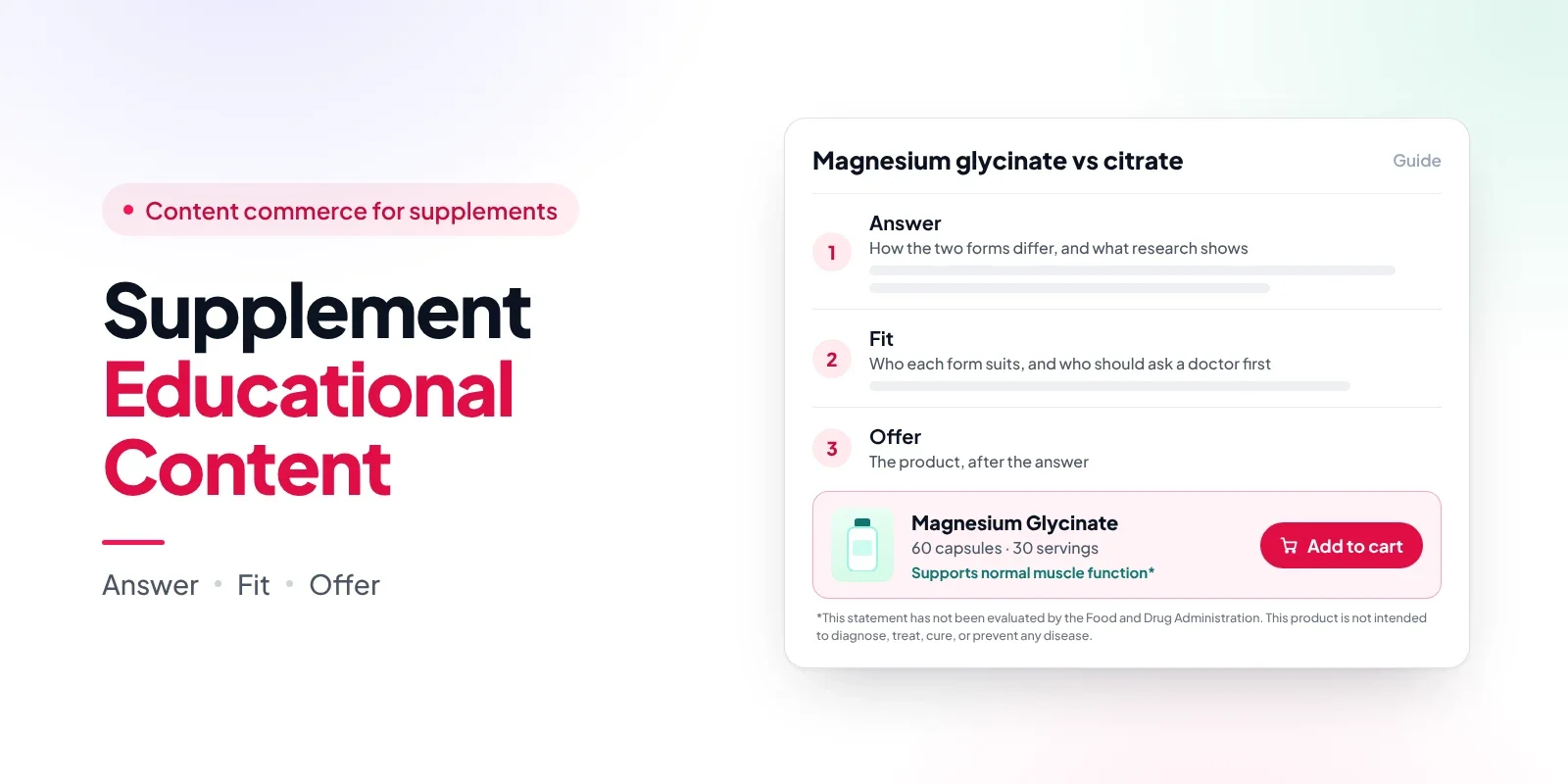
Short answer: Supplement educational content sells when it follows an Answer, Fit, Offer order. First answer the reader's question honestly, including what the ingredient doesn't do. Then show who the product fits and who it doesn't. Only then offer the product, usually one product or a starter pack, with the FDA disclaimer next to any structure/function claim. Keep claims to what your evidence supports and measure repeat purchases, not just first orders.
TL;DR
Supplement readers buy after they understand, so the product goes below the answer, never above it.
Use the Answer, Fit, Offer order: answer the question, show who the product fits and doesn't, then offer it.
The best-selling pages answer specific questions: ingredient explainers, form comparisons, "how to choose," and "how to take" guides.
Offer one product or a starter pack on most pages, and send subscribers to a page that supports subscriptions.
Structure/function claims need the FDA disclaimer on the page, and disease claims don't belong in supplement content at all.
Measure revenue per page and the repeat rate of customers who arrived through content.
What is supplement educational content?
Supplement educational content is any page a supplement brand publishes to help people understand an ingredient, a health goal, or a product choice, such as an ingredient explainer, a comparison of two forms of a nutrient, or a guide to taking a supplement. When it sells, the product appears on the same page, after the explanation, so the reader can buy without searching for it.
It isn't an advertorial dressed up as an article, and it isn't a product page with a long description. The test is simple: would the page still be useful to a reader who never buys? If yes, it's educational content. If the page only makes sense as a sales pitch, readers can tell, and so can search engines.
Why supplement brands sell through educational content
Supplement buyers look for information before they buy, and a large share of them listen to brands. In the Council for Responsible Nutrition's 2026 survey of 3,005 U.S. adults, 51% said supplement company materials influence their supplement decisions, behind doctors at 77% and ahead of social media creators at 35%. The same survey found that 81% say scientific evidence is very or somewhat important when they decide whether a supplement is right for them.
That information isn't always easy to find. In Thorne's Wellness Confidence Gap survey of 3,013 U.S. consumers, 56% said there's too much conflicting information about which supplements are right for them, and 57% said they're unsure which products are best for them. Clinical research and scientific evidence was the most-cited must-have when choosing a supplement.
Put those together and the opportunity is clear. Readers want guidance, many of them trust brand materials, and they're confused by what they've read elsewhere. A brand that answers the question clearly earns the right to show its product. A brand that skips the answer and pushes the product looks like every other ad the reader has learned to ignore.
There's also a second reason that's specific to supplements: people reorder them. A customer who buys because they understood why a product fits them is more likely to keep taking it than one who bought on a discount, and that repeat purchase is where most of a supplement brand's revenue comes from.
Answer, Fit, Offer: the order that makes supplement content sell
Most supplement pages that fail to sell have the right content in the wrong order. The fix is to follow the order in which a careful reader actually decides.
1. Answer the question first
Start with the answer the reader searched for, in the first few lines. If the page is "magnesium glycinate vs citrate," say what the difference is before anything else. Include what the ingredient doesn't do and what the research doesn't show. An honest limit builds more trust than another benefit, and it keeps you on the right side of the claim rules covered below.
2. Show who the product fits, and who it doesn't
After the answer, help the reader place themselves. Who usually chooses this form or ingredient? Who should talk to a doctor first, such as people who are pregnant or taking certain medications? A short "who this is not for" section is one of the most useful things a supplement page can have. It filters out buyers who would return the product, and it shows the reader you aren't selling to everyone.
3. Offer the product, with the right claim beside it
Only now does the product appear, as a product card with the name, the form, the serving, the price, and a way to buy. Put the claim you're making and the FDA disclaimer next to the card, not in a footer. A second, smaller card at the end of the page catches readers who scroll to the bottom first.
What the offer should not be: a pop-up before the answer, a banner at the top of the article, or a grid of 12 bestsellers in the sidebar. Each of those asks for a decision before the reader has the information to make one.
Which supplement educational content sells
Not every educational page should sell. A general "what is gut health" article reaches people at the very start of their research, and a product card there mostly gets ignored. Pages that answer a specific choice sell much better, because the reader is already close to a decision.
Content type | The reader's question | Where the product goes | What to put on the page | What to watch |
|---|---|---|---|---|
Ingredient explainer | "What is this and what does the research say?" | After the evidence section | One product | Don't overstate what the studies show |
Form comparison ("glycinate vs citrate") | "Which version should I take?" | After the comparison, one card per form if you sell both | One card per form | Compare fairly, even if you sell only one form |
"How to choose" guide | "What should I look for on a label?" | After the checklist | One product, or two for different needs | Label claims must match the actual label |
"How to take" guide (timing, with food, dose) | "How do I use this?" | Near the routine summary | The product plus a reorder option | Don't give dosing advice beyond the label |
Stack or routine guide | "What goes together?" | After the routine | A starter pack or preset bundle | Every product in the stack needs its own support |
Quality and testing page | "Can I trust this brand?" | Beside the test results | Bestsellers that the tests cover | Only show tests you can share |
"Who this is not for" | "Is this safe for me?" | Usually no product, or a soft link | Nothing, or a link to the product page | Don't turn safety content into a sales page |
Two of these deserve extra attention. Form comparisons are some of the most-searched supplement questions, because readers don't know which version to pick, and the page answers exactly the question that stands between them and a purchase. "How to take" guides reach people who already bought or are about to, so they're a natural place for a reorder or subscription option.
What to put on the page: one product, a starter pack, or a subscription
The basket for most supplement pages is small. A reader usually comes to one page to solve one question, so one product is the right default.
One product. Use it on explainers and comparisons. Show the form, the serving size, the number of servings per container, and the price per serving if that's how your category is compared.
A starter pack. Use it when the page explains a routine that genuinely needs more than one product, or when a smaller trial size lets a hesitant reader try before committing. Keep the pack fixed and explain why each item is in it. This is the same logic as a stack sold next to a workout plan, the way fitness blogs sell gear inside workout content.
A subscription. Supplements are a natural fit for subscribe-and-save, but a subscription is a separate decision from a first purchase, and the setup has limits. Shopify says that to sell subscriptions you need a subscription app from the Shopify App Store, and that subscription-only products without a one-time purchase option can be sold only on the Online Store sales channel. If your content lives on an external site, keep a one-time option on the product and send readers who want a subscription to the product page in your store.
A practical pattern for most brands is to offer a one-time purchase on the educational page, then offer the subscription in the post-purchase email when the customer is about to run out.
Claim-safe supplement content: what you can say
This is the most regulated category in content commerce, and the rules apply to educational pages as well as product pages. An article that sells a product is advertising, and FDA and FTC actions against supplement companies regularly quote claims from company websites, blogs, and social posts. This isn't legal advice, so check your wording with a regulatory advisor. But the basics are clear enough to write by.
Structure/function claims need the FDA disclaimer. A structure/function claim describes how a nutrient affects the body's normal structure or function, such as "supports healthy immune function." The FDA says these claims must be accompanied by this disclaimer: "This statement has not been evaluated by the Food and Drug Administration. This product is not intended to diagnose, treat, cure, or prevent any disease." The company must have evidence the claim is truthful and not misleading, and must notify the FDA no later than 30 days after first marketing the supplement with the claim.
Disease claims don't belong in supplement content. A claim that a supplement diagnoses, treats, cures, mitigates, or prevents a disease turns it into an unapproved drug claim, and the disclaimer doesn't fix that. Single words make the difference:
Disease claim (avoid) | Structure/function wording (needs evidence and the disclaimer) |
|---|---|
"Prevents colds and flu" | "Supports healthy immune function" |
"Relieves arthritis pain" | "Supports joint comfort" |
"Cures insomnia" | "Supports restful sleep" |
"Lowers high cholesterol" | "Helps maintain cholesterol levels already within a normal range" |
"Treats anxiety" | "Promotes a sense of calm" |
These are examples of the difference, not approved wording. Whether a specific claim is acceptable depends on your product and your evidence.
The FTC expects real evidence for health claims. The FTC's Health Products Compliance Guidance says health claims need "competent and reliable scientific evidence," which for health benefits generally means good-quality human clinical trials. Words like "may" or "helps" don't make an unsupported claim acceptable.
Put the disclaimer where the claim is. The FTC guidance also says disclosures for health claims should be hard to miss, and that a disclosure behind a hyperlink can be avoided. For an educational page, that means the FDA disclaimer belongs near the claim and the product card, marked with an asterisk, not only in a footer link.
Check the product description, too. Many embed tools and buy buttons pull the product description from Shopify. If your Shopify description says something you'd never write in the article, it will appear on the page anyway. Audit descriptions before you embed them.
Beauty brands face a similar line between cosmetic and drug wording, and the cosmetic-versus-drug line in beauty tutorials works the same way: the claim, not the product category, decides how a regulator reads it.
Reviews, practitioners, and creators in supplement content
Social proof works in supplements, but it carries more risk here than anywhere else.
Customer reviews. A customer's own review is generally seen as their opinion. Once you quote it in an article, put it in an email, or use it as a headline, it starts to look like your claim. If a review says "this cured my migraines," don't feature it. The FTC guidance says testimonials can't be used to make claims you couldn't support directly, and that you need evidence the product will work for buyers the way it did for the reviewer.
Practitioners. Many supplement brands sell through chiropractors, dietitians, naturopaths, and personal trainers who write about products on their own sites. The FTC expects expert endorsers to have real expertise in the area, to have actually evaluated the product, and to disclose any material connection, such as commissions or free product.
Creators. Creators who get paid or receive free products need to disclose that clearly, and a "buy now" button isn't a disclosure. Give them simple wording to use and check that they use it. For partners who write on their own sites, choosing between affiliate links and embeds for each partner depends on where that partner's readers make the decision.
Where your supplement content lives and what works there
The right setup depends on where the educational page is published. Start with what Shopify already gives you.
Where the content lives | Native Shopify option | Limits to know | App option |
|---|---|---|---|
Your Shopify online store blog | Your theme's product sections, where your theme has them; cart permalinks for starter packs | Depends on your theme | Not needed for most brands |
A separate education site or blog (WordPress, Webflow, Wix) | Shopify Buy Button channel | Subscription-only products can't be sold outside the Online Store channel; a pack needs a manual cart permalink | An embed app such as EmbedUp for product cards, collections, and preset packs |
A practitioner's or creator's site | Buy Button channel; links and discount codes | Doesn't tie a button to a specific partner without additional steps | EmbedUp Pro to assign a product block to a partner and track their sales |
YouTube, Instagram, TikTok, podcasts | Links, codes, and each platform's shopping features | Embeds can't run inside these apps | Link to a written version of the content on your site |
Links and cart permalinks | Embeds can't run in email | Links and codes |
Shopify's Buy Button is free and handles single products, but the limits of Shopify's Buy Button show up quickly once you need packs, partner tracking, or many pages.
EmbedUp, a Shopify app by EFOLI for selling products on external websites, is one option for educational content that lives outside your Shopify store. Its free Starter plan covers one component with up to three products, enough to test one article. The Growth plan ($14.99/month) adds preset bundles with fixed products and quantities, one-click add-all-to-cart, default quantities per variant, and an inventory check before checkout. The Pro plan ($29.99/month) adds affiliate partners, component assignment, commission tracking, UTM campaign analytics, and order-level attribution. EmbedUp doesn't list subscription purchase options, so link subscribers to your product page.
For an example of the format in practice, one brand put a shoppable product card on a wellness content page, with the product story and education placed before the purchase option.
Example: a form comparison page, step by step
Here's how the magnesium brand from the introduction could rebuild its comparison article. The brand and details are illustrative.
Answer first. The opening paragraph says that both forms are magnesium bound to a different compound, that the forms differ in how much elemental magnesium each serving contains and in how they're commonly described for digestive comfort, and that neither form is right for everyone.
Compare fairly. A table compares the two forms on elemental magnesium per serving, common reasons people choose each one, and what studies do and don't show. The brand sells only glycinate but describes citrate honestly.
Show fit. A short section explains who tends to choose each form and who should check with a doctor first, such as people with kidney conditions or those taking certain medications.
Offer. After the comparison, a product card shows the glycinate product, its serving size, servings per container, and price. The card's line reads "Supports normal muscle function*", with the FDA disclaimer directly underneath.
Close. A smaller card at the end repeats the product, with a one-time purchase option. The post-purchase email offers the subscription three weeks later.
The page reads as a useful comparison first. The product appears exactly where a reader who has decided on glycinate would want it.
How to measure sales from supplement educational content
Supplement educational content often looks weak if you only count first orders, because its real value shows up in repeat purchases.
Revenue per page. Track orders and revenue for each educational page, plus revenue per visit so you can compare pages with different traffic.
Repeat rate of content customers. Compare how often customers who first bought through content reorder, against customers from discounts or ads.
Time to second order. If content customers reorder on schedule, the page sold to the right people.
Refunds and complaints. A page that drives refunds is probably overpromising.
Tracking. Give each page its own product block or UTM-tagged link. Shopify's order details can show referrer and UTM data, but it won't credit every sale. An embed tool with order-level attribution makes results by page clearer.
Give each page 60 to 90 days before judging it. Educational pages build search traffic slowly, and reorders take at least one supply cycle to show up.
Mistakes that stop supplement content from selling
The product comes before the answer. A banner or card above the explanation asks for a decision too early.
Every page sells everything. A sidebar of bestsellers on an ingredient explainer distracts from the one product that fits.
Claims outrun the evidence. "Clinically proven" on an ingredient studied in a different dose or form is a common problem.
The disclaimer is hidden. A disclaimer only in the footer, or behind a link, isn't next to the claim it covers.
Reviews make disease claims. Featuring a review that says a product cured something makes it your claim.
Subscriptions are pushed on first visit. Readers who haven't tried a product often won't commit to a recurring charge.
Practitioners and creators don't disclose. Undisclosed paid endorsements are a risk for the brand, not only the partner.
Supplement educational content and AI search
AI assistants answer many of the same questions supplement pages target, such as "which magnesium form should I take?" They tend to cite pages that give a clear, direct answer, explain limits, and separate facts from marketing. That's the same structure Answer, Fit, Offer produces.
A few habits make supplement educational content easier to cite: put a short answer near the top, use tables for comparisons, name ingredients and forms precisely, cite the studies you rely on, and keep the product section clearly separate from the education. If the page is cited, the product card is what turns that visit into a sale, which is what happens after an AI assistant cites a shoppable post.
Limitations of selling supplements through educational content
Supplement educational content is one of the most reliable ways to sell supplements, but it has limits:
It's slow. Search traffic and reorders take months to build.
Claims limit what you can say. Some of the benefits readers want to hear about are disease claims you can't make.
It doesn't create demand by itself. If nobody searches for the question, adding a product won't change that.
Embeds can't run everywhere. Video, social, podcasts, and email need links and codes.
Subscriptions need extra setup. You need a subscription app, and subscription-only products are limited to the Online Store channel.
Attribution is never complete. A reader who learns on your blog and buys later from a marketplace won't be credited to the page.
Tool limits apply. On EmbedUp, the free plan covers one component with up to three products, preset packs need Growth, and partner tracking needs Pro.
Conclusion
Supplement educational content sells when it respects how a careful reader decides: answer the question, show who the product fits, and only then make the offer. That order builds the trust supplement buyers look for, keeps claims in line with your evidence, and brings in customers who are more likely to reorder.
Start with one page that already gets traffic, ideally a form comparison or "how to choose" guide. Move the product below the answer, add the right claim and the FDA disclaimer next to it, and measure revenue and reorders for 60 to 90 days. If that content lives outside your Shopify store, EmbedUp is one way to add synced product cards, starter packs, and partner tracking to those pages.
What is supplement educational content?
Can supplement brands sell directly from blog posts?
Where should the buy button go in a supplement article?
Do supplement blog posts need the FDA disclaimer?
What's the difference between a structure/function claim and a disease claim?
Can I feature customer reviews in supplement content?
Can I sell supplement subscriptions from an external blog?
How do I measure sales from supplement educational content?
- supplement educational content
- supplement brands selling through educational content
- supplement content marketing
- structure/function claims
- sell supplements online with content
Related articles
 Content Commerce
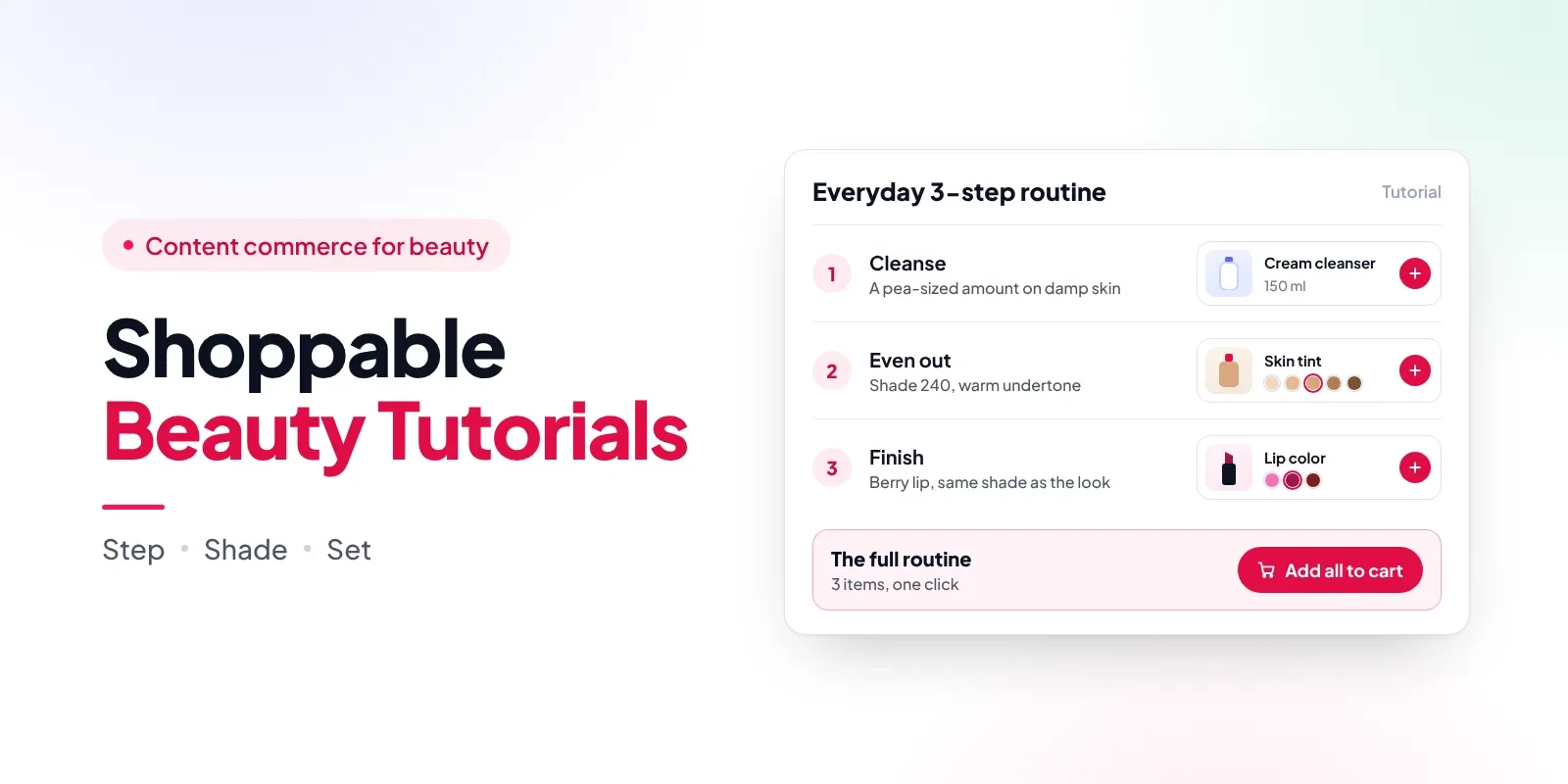
Shoppable Beauty Tutorials: How Beauty Brands Sell Every Step
Beauty brands selling through tutorials win when each step names the exact product and shade, and the reader can buy the whole routine without leaving. Here's what to embed, where, and what to watch.
20 min read
 Content Commerce
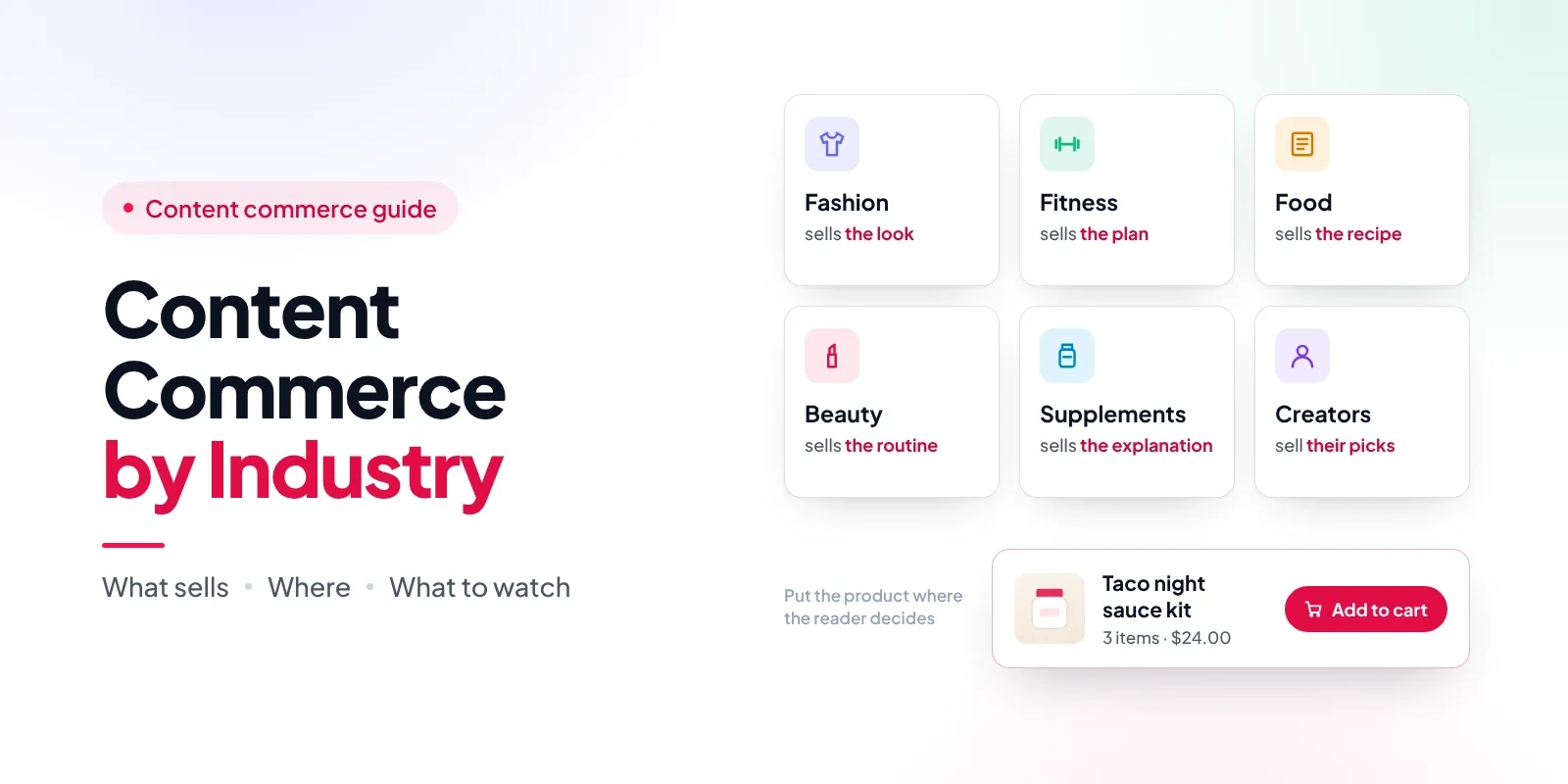
 Examples: How 6 Industries Sell Through Content
Fashion brands sell the look, food brands sell the recipe, and supplement brands sell the explanation. Here's how six industries use content commerce, what to put on the page, and what to watch in each.
24 min read
 Embed Shopify Products
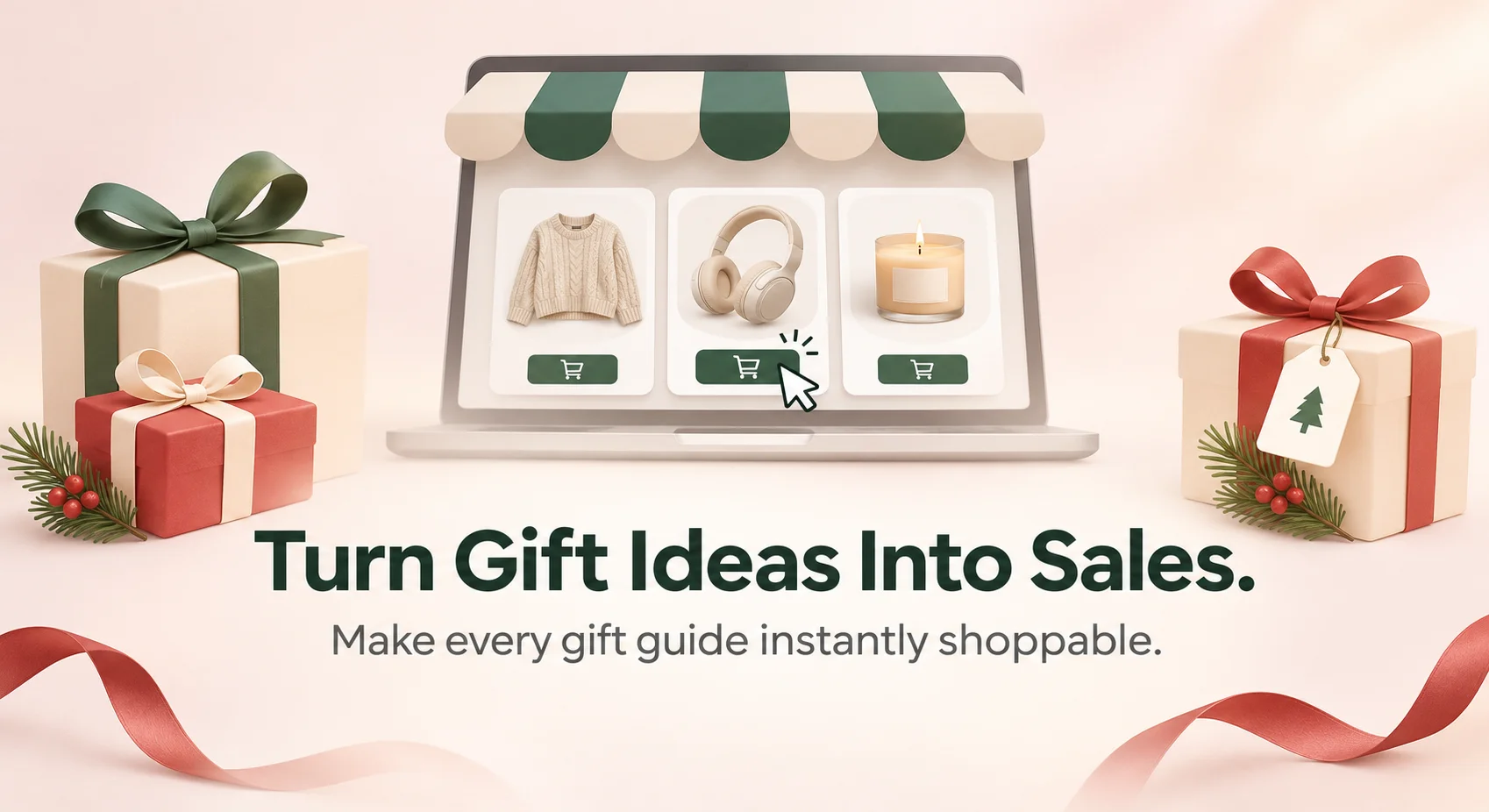
How to Make a Shoppable Holiday Gift Guide Readers Can Buy From
Last checked: 2 November 2026, against the EmbedUp App Store listing, embedup.com, ShipStation's 2026 holiday shipping deadlines, and the NRF 2026 holiday forecast. Who this is for: Shopify merchants, bloggers, and content teams who publish a holiday gift guide on a blog or website. Reading time: about 16 minutes.
17 min read