Shoppable Beauty Tutorials: How Beauty Brands Sell Every Step
 Syeda Rehnoma Tanzom20 min read
On this page
- What is a shoppable beauty tutorial?
- Why beauty brands sell through tutorials
- The Step, Shade, Set method
- Step: the product appears where it's used
- Shade: the reader can see which option is theirs
- Set: the whole routine is one click away
- What to embed in each type of beauty tutorial
- How to handle shade in a shoppable makeup tutorial
- How to sell a skincare routine set inside a tutorial
- Claim-safe tutorial copy: what beauty brands can say
- Creator and makeup artist tutorials: disclosure and credit
- Where your beauty tutorials live and what works there
- Example: two shoppable beauty tutorials, step by step
- How to measure sales from beauty tutorials
- Mistakes that stop beauty tutorials from selling
- Shoppable beauty tutorials and AI search
- Limitations of selling through beauty tutorials
- Conclusion
Picture a small makeup brand whose most-read post is "My five-minute everyday makeup routine." It brings in steady search traffic every week, but almost no sales. Readers who like the look scroll to a "Shop the products" list at the bottom, click through to a foundation page with 30 shades, try to work out which one the model was wearing, and leave. (The brand is illustrative, but the pattern is common.)
The tutorial did its job. It showed the reader how to get the look and made them want it. The page broke at the next two questions: which shade is right for me, and where do I buy all of this? That's the gap shoppable beauty tutorials close, and it's the same one we see when we look at how brands in different industries sell through content: the product has to be there at the moment the reader decides.
It matters more in beauty than in most categories. A tutorial is where a beauty buying decision is actually made, and a reader who has to leave, find each product, and guess a shade often doesn't finish. Even when they do, a wrong shade turns a sale into an exchange or a return.
This guide shows how to sell beauty products through tutorials: what to put at each step, how to handle shade, when to sell the routine as a set, what you can safely say in tutorial copy, and how to measure the result.
Short answer: Shoppable beauty tutorials let readers buy the products a tutorial uses at the step where they're used, with the exact shade or skin type shown. Beauty brands sell through tutorials by answering three questions at the decision point: which product at this step, which shade for me, and can I buy the whole routine at once. Keep tutorial copy to cosmetic claims, disclose any paid or gifted creator, and measure sales per tutorial.
TL;DR
Tutorials are where beauty buying decisions happen, so put the product at the step, not at the bottom of the post.
Answer Step, Shade, Set: the product for each step, the shade for this reader, and the whole routine in one click.
Match the format to the tutorial: per-step cards for complexion, a routine set for skincare, a fixed set for a get-the-look.
Name the exact shade in the step text, show shade options on the card, and keep shade-dependent products out of fixed sets.
Tutorial copy counts as promotional material, so avoid treatment claims and disclose every paid or gifted creator.
Track revenue per tutorial and shade-related exchanges, then expand from your best-selling tutorial.
What is a shoppable beauty tutorial?
A shoppable beauty tutorial is a makeup, skincare, or hair tutorial where the reader can choose and buy each product at the step that uses it, without leaving the page. Checkout still runs through your store, which for Shopify brands means Shopify checkout.
It isn't a tutorial with a "shop now" link at the end, or a grid of bestsellers in the sidebar. Those send the reader somewhere else to rebuild the routine. A shoppable tutorial puts the product, its shade or skin-type options, and an add-to-cart button next to the instruction that explains how to use it.
The format works for written tutorials with step photos, video tutorials with written steps underneath, and routine posts such as "my morning skincare routine for dry skin."
Why beauty brands sell through tutorials
Beauty shoppers have two questions before they buy: how do I use this, and will it work for me? A tutorial answers both, which is why it's the format beauty buyers go looking for. In Tinuiti's survey of 1,003 U.S. beauty shoppers in January 2025, reviews were the most-watched type of beauty video and tutorials were the second most-watched, with makeup buyers showing particular interest in tutorials.
More of those decisions now end in an online order. McKinsey reports that online channels made up 26% of global beauty sales in 2024 and expects them to reach nearly one-third by 2030.
Social platforms get most of the attention, but tutorials on pages you own have three advantages. You decide where the product appears, you can give as much shade and ingredient detail as the reader needs, and the sales data is yours. Content-first beauty brands aren't new either. Glossier grew out of Emily Weiss's beauty blog, Into the Gloss, before it sold a single product.
The Step, Shade, Set method
A beauty tutorial sells when it answers three questions at the moment the reader decides. We call this the Step, Shade, Set method.
Step: the product appears where it's used
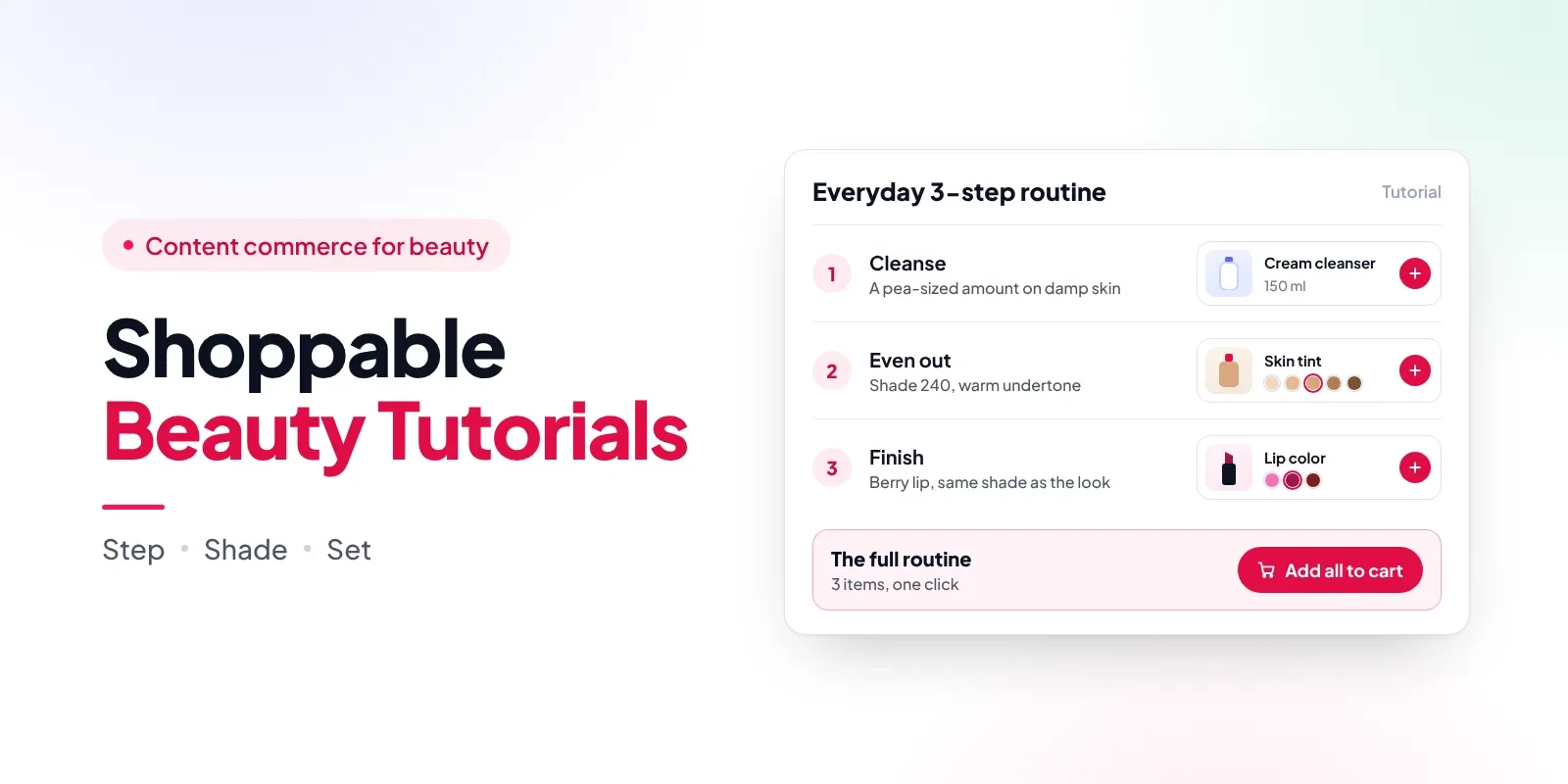
Each step names the product it uses and puts it right there, with how much to use and why. "Apply two pumps of the hydrating serum to damp skin" next to the serum's product card is a recommendation. The same serum in a list at the bottom of the post is an ad the reader has to go looking for.
Shade: the reader can see which option is theirs
When a product comes in shades, undertones, or skin-type versions, the step names the exact one used in the tutorial, and the product card lets the reader pick their own. A reader who has to guess a shade on another page is the reader most likely to leave.
Set: the whole routine is one click away
Many readers want everything in the tutorial. Give them the full routine as one set at the end of the steps, and still let them buy any single step on its own for the product they've run out of.
A tutorial that answers all three reads like advice from someone who knows the products, not like a catalog with instructions.
What to embed in each type of beauty tutorial
Not every tutorial needs the same format. Where the decision happens, and whether shade decides it, changes what you should put on the page.
Tutorial type | Where the reader decides | What to embed | Main risk | What to measure |
|---|---|---|---|---|
Complexion (foundation, concealer, tinted moisturizer) | At the step where the product goes on and the shade is named | One product card per step, with shade options visible, plus a shade guide link | Wrong shade, exchanges, and returns | Shade-related exchanges and returns per tutorial |
Skincare routine (morning, evening, by skin type) | When the reader sees the full routine and what each step does | A routine set at the end, plus a card at each step | Treatment claims such as "clears acne" | Set adds vs single-product adds |
Get-the-look (eye, lip, full face) | When the reader sees the finished look | A fixed set of the exact shades used, plus single cards | Photos that don't match real color | Add-to-cart per look |
Technique or tool (brush, sponge, curling tool) | At the technique step that needs the tool | A single product at that step | Overpromising results | Sales per tutorial |
Hair routine (by hair type) | When the reader identifies their hair type | One set per hair type | Drug-like claims about dandruff or hair loss | Set adds by hair type |
Creator or makeup artist tutorial | When the creator explains why they use it | The creator's picks, credited to them | Missing disclosure | Sales per creator |
If one tutorial fits two rows, such as a "no-makeup makeup" tutorial that includes skincare and a foundation, use the stricter rule for each product: the shade rule for the foundation and the claims rule for the skincare.
Shade does for beauty what size does for fashion. It decides whether a ready-made set can work, which is why the same set-or-single thinking behind selling complete outfits from a fashion blog applies to a full-face tutorial.
How to handle shade in a shoppable makeup tutorial
Shade is the biggest reason a beauty reader hesitates online. In The Benchmarking Company's March 2026 survey of more than 4,000 U.S. female beauty buyers, 41% find shade matching frustrating for face products. In the same survey, 51% said shades look different in photos than in real life, and 38% said they guess their shade from the product description.
A shoppable makeup tutorial can't put the product on the reader's skin, but it can remove most of the guessing:
Name the shade and undertone in the step. "I'm wearing shade 240, a medium shade with warm undertones" is more useful than "my foundation."
Show more than one skin tone where you can. If the tutorial uses one model, say which shade the model wears and suggest the nearest shades for lighter and deeper skin.
Put shade options on the product card. The reader should pick their shade on the tutorial page, not on a product page they have to find.
Place your shade guide next to the card. Not in the footer and not at the end of the post.
Keep shade-dependent products out of fixed sets. A fixed set locks in one shade. Sell the rest of the routine as a set and the foundation or concealer as its own card beside it.
Two small habits help too. Say what lighting the photos were taken in, since color changes between daylight and a ring light. And keep an eye on discontinued shades. A tutorial can rank for years, long after a shade has gone. Product embeds that sync from Shopify show current prices and stock; screenshots and copied links don't.
How to sell a skincare routine set inside a tutorial
When the routine itself is what the reader wants, such as "a three-step morning routine for dry skin," a skincare routine set is the right format. The reader has already decided to follow the routine. A set lets them buy it in one step instead of three.
Put the set right after the last step, with a one-line summary of what's in it, and keep each step's own product card above it for readers who only need one item. If a routine uses more of one product than another, set the quantities to match how long each lasts, so the reader doesn't run out of serum two weeks before the cleanser.
Build sets around skin type, not price tier. "Dry skin routine" and "oily skin routine" match how readers think about themselves; "starter" and "deluxe" don't tell them which one is for them. Food brands work the same way: selling recipe ingredients as one kit works because the recipe defines what goes in the basket, and a routine does that job for skincare.
If your tutorials live on your Shopify online store blog, you don't need an app for this. A Shopify cart permalink can add several variants with set quantities in one link, so an "Add the whole routine" button can send the reader to checkout or the cart with every product already added.
Claim-safe tutorial copy: what beauty brands can say
Write tutorial copy as carefully as you'd write a label. The U.S. Food and Drug Administration (FDA) says a product's intended use can be shown by claims "on the product labeling, in advertising, on the Internet, or in other promotional materials." A tutorial that sells a product is promotional material.
That matters because claims decide whether a product is a cosmetic or a drug. The FDA says a cleanser intended to treat acne can be regulated as a drug, or as both a drug and a cosmetic. Antidandruff shampoo is both, and moisturizers or makeup marketed with sun-protection claims are cosmetic/drug products. Claims about changing the structure or function of the body, including the skin, also make a product a drug.
Drug-like wording (avoid unless the product is sold as an OTC drug) | Cosmetic wording |
|---|---|
"Clears acne" or "treats breakouts" | "Removes excess oil and leaves skin feeling clean" |
"Boosts collagen" or "reverses wrinkles" | "Makes fine lines look less visible" |
"Stops hair loss" or "regrows hair" | "Makes hair look fuller" |
"Treats dandruff" | "Washes away dirt and oil from the scalp" |
"Protects against sun damage" (without being a sunscreen) | "Gives skin a dewy, healthy-looking finish" |
"Heals irritated skin" | "Leaves skin feeling soft and comfortable" |
Two details are easy to miss. First, if your embedded product card shows the Shopify product description, that text is on the tutorial page too, so check it with the same care. Second, the FDA says it "does not have a list of approved or accepted claims for cosmetics." Any claim has to be truthful and not misleading, and the Federal Trade Commission (FTC) regulates advertising claims. This isn't legal advice, so check your wording with an advisor, especially for acne, anti-aging, sun, and hair-growth products.
Creator and makeup artist tutorials: disclosure and credit
Tutorials made by creators and makeup artists often sell better than brand-made ones, because the audience trusts the person. They also need two things agreed before they go live: a disclosure and a way to credit sales.
The FTC's Endorsement Guides FAQ says creators who receive free products with the expectation of promoting them need to disclose that. In a video, the disclosure belongs in the video itself, ideally near the start, not only in the description. The FTC also says the words "affiliate link" alone may not tell readers the creator is paid, and that a "buy now" button isn't an adequate disclosure. Brands are responsible for what others do on their behalf, so give creators simple wording, such as "This brand sent me these products and I earn a commission on sales from this page," and check that it's used.
For credit, give each creator their own product block or tracked link, so each sale from their tutorial is credited to them. Creators who publish on their own sites face the same questions from the other side, and makeup bloggers earning commissions on beauty products need the same clarity on terms and tracking. Some partners suit a plain link and others an embed, and choosing between affiliate links and embeds for each partner comes down to where that partner's audience makes the decision.
Where your beauty tutorials live and what works there
The right setup for shoppable beauty tutorials depends on where the tutorial is published. Start with what Shopify already gives you.
Where the tutorial lives | Native Shopify option | Limits to know | App option |
|---|---|---|---|
Your Shopify online store blog | Your theme's product sections, where your theme has them; cart permalinks for routine sets | Depends on your theme | Not needed for most brands |
An external blog or content site (WordPress, Webflow, Wix) | Shopify Buy Button channel (included in all plans) | Shopify doesn't recommend Buy Buttons on your Shopify store; a set needs a manual cart permalink | An embed app such as EmbedUp for product cards with variants, collections, and preset sets |
A creator's or makeup artist's site | Buy Button channel; links and discount codes | Doesn't tie a button to a specific partner without additional steps | EmbedUp Pro to assign a product block to a partner and track their sales |
YouTube, TikTok, Instagram | Links, codes, and each platform's own shopping features | Embeds can't run inside these apps | Link to a written version of the tutorial on your site |
Links and cart permalinks | Embeds can't run in email | Links and codes |
Shopify's Buy Button is free and handles single products well, but it's worth knowing the limits of Shopify's Buy Button before you build a whole tutorial library on it. Many beauty brands run their content on WordPress, and embedding Shopify products on WordPress takes a pasted embed code rather than a rebuilt site.
EmbedUp, a Shopify app by EFOLI for selling products on external websites, is one option for tutorials that live outside your Shopify store. Its free Starter plan covers one component with up to three products, which is enough to test a single tutorial step. The Growth plan ($14.99/month) adds preset bundles with fixed products and quantities, one-click add-all-to-cart, and an inventory check before checkout, which covers routine and get-the-look sets. The Pro plan ($29.99/month) adds creator and affiliate partners, component assignment, and order-level attribution.
Example: two shoppable beauty tutorials, step by step
Both examples are illustrative.
A dry-skin morning routine. A skincare brand publishes "A three-step morning routine for dry skin."
Step 1 says "Massage a pea-sized amount of cream cleanser onto damp skin, then rinse." The cleanser's card sits beside it.
Step 2 says "Press two pumps of hydrating serum into skin while it's still damp." The serum's card sits beside it.
Step 3 says "Finish with the moisturizer, using a little more on dry patches." The moisturizer's card sits beside it.
After the steps, a "Dry skin morning routine" set adds all three at once. The copy talks about how skin looks and feels, never about treating a condition.
A berry lip get-the-look. A makeup brand publishes "How to wear a berry lip for the holidays."
The lip liner, lipstick, and gloss each appear at their step, with the exact shade names in the text.
Because the shades are the look, a fixed set of those three shades works here. A second set with the deeper version of the look sits beside it for readers with deeper skin tones.
The intro says the photos were taken in daylight, and the shade guide link sits next to the set.
In both cases, the reader can follow the tutorial, pick their option, and buy without leaving the page.
How to measure sales from beauty tutorials
Treat shoppable beauty tutorials as sales pages, not just traffic pages. For each tutorial, track orders, revenue, add-to-cart clicks, and revenue per visit. Revenue per visit is the fairest way to compare a long routine guide with a short technique post.
Then add the signals that matter in beauty:
Set adds vs single adds, which tells you whether readers want the whole routine or just one step.
Shade-related exchanges and returns by tutorial, which shows whether your shade information is doing its job.
Repeat orders of the routine, since skincare buyers who like a routine tend to rebuy it.
Sales per creator, for partner tutorials.
Tag every link you control with UTM parameters. Shopify's order conversion summary can show the referrer and UTM details for an order, but it can be limited, so don't treat it as a complete record. Embedded products that report sales by placement make tutorial-level results easier to see, and EmbedUp's Pro plan adds UTM campaign analytics and order-level attribution. Give each tutorial 60 to 90 days before you judge it, since tutorials often build search traffic slowly.
Mistakes that stop beauty tutorials from selling
Putting every product at the bottom of the post. The reader decides at the step, not after the last paragraph.
Embedding a catalog grid. Twelve bestsellers under a tutorial look like an ad. Show only what the tutorial uses.
Not naming the shade. "My favorite foundation" leaves the reader guessing. Name the shade and undertone.
Locking a shade product inside a fixed set. Sell the complexion product separately so each reader can choose their own shade.
Writing treatment claims in tutorial copy. If you couldn't put it on the label, don't put it in the tutorial or the product description the card shows.
Publishing creator tutorials without disclosure or credit. Agree on both before the post goes live.
Publishing video-only tutorials. Without written steps, readers can't skim, search engines have less to rank, and AI assistants have nothing to quote.
Shoppable beauty tutorials and AI search
AI assistants cite pages that answer a question clearly in text. A written tutorial that names each product, shade, and step gives them something to quote. A video with no written steps usually doesn't. You control your own pages; you don't control how AI tools rank or describe products.
The fix is simple: pair every video tutorial with the written steps on the same page, name the products and shades in the text, and open with a one-paragraph answer. That page can be cited, and the product cards give the reader who clicks through something to buy. It also helps to understand what happens after an AI assistant cites a shoppable post, since the visit that follows is often from a reader who is close to buying.
Limitations of selling through beauty tutorials
Shoppable beauty tutorials work best when the tutorial already reaches readers close to a decision. They have real limits:
They can't solve shade on a screen. Good shade information reduces guessing, but some readers will still buy the wrong shade.
They don't create traffic. If nobody reads the tutorial, adding products won't change that.
Embeds can't run everywhere. YouTube, TikTok, Instagram, and email need links and codes.
Claims limit what you can say. Skincare, sun, and hair products need careful wording.
Attribution is never complete. A reader who watches a tutorial and buys a week later in your store may not be credited to it.
Tool limits apply. On EmbedUp, the free plan covers one component with up to three products, preset sets need Growth, and partner tracking needs Pro.
Conclusion
Shoppable beauty tutorials work because they put the product where a beauty decision is actually made: at the step, with the shade named, and with the whole routine one click away. That's the Step, Shade, Set method, and it applies whether you publish a skincare routine, a get-the-look, or a complexion tutorial.
Start with one tutorial that already gets traffic. Put the product at each step, name the shade, add the routine as a set where it makes sense, check your claims, and measure it for 60 to 90 days. If your tutorials live outside your Shopify store, EmbedUp is one way to add synced products, routine sets, and creator tracking to those pages.
What is a shoppable beauty tutorial?
How do beauty brands sell through tutorials?
Should I sell a skincare routine as a bundle or as separate products?
How do I show shade options in a shoppable makeup tutorial?
Can I embed Shopify products in a YouTube or TikTok tutorial?
What claims can I make in a skincare tutorial?
Do creators need to disclose gifted products in makeup tutorials?
How do I track which tutorial made a sale?
- shoppable beauty tutorials
- beauty brands selling through tutorials
- sell beauty products through tutorials
- skincare routine set
- shoppable makeup tutorial
Related articles
 Content Commerce
 Examples: How 6 Industries Sell Through Content
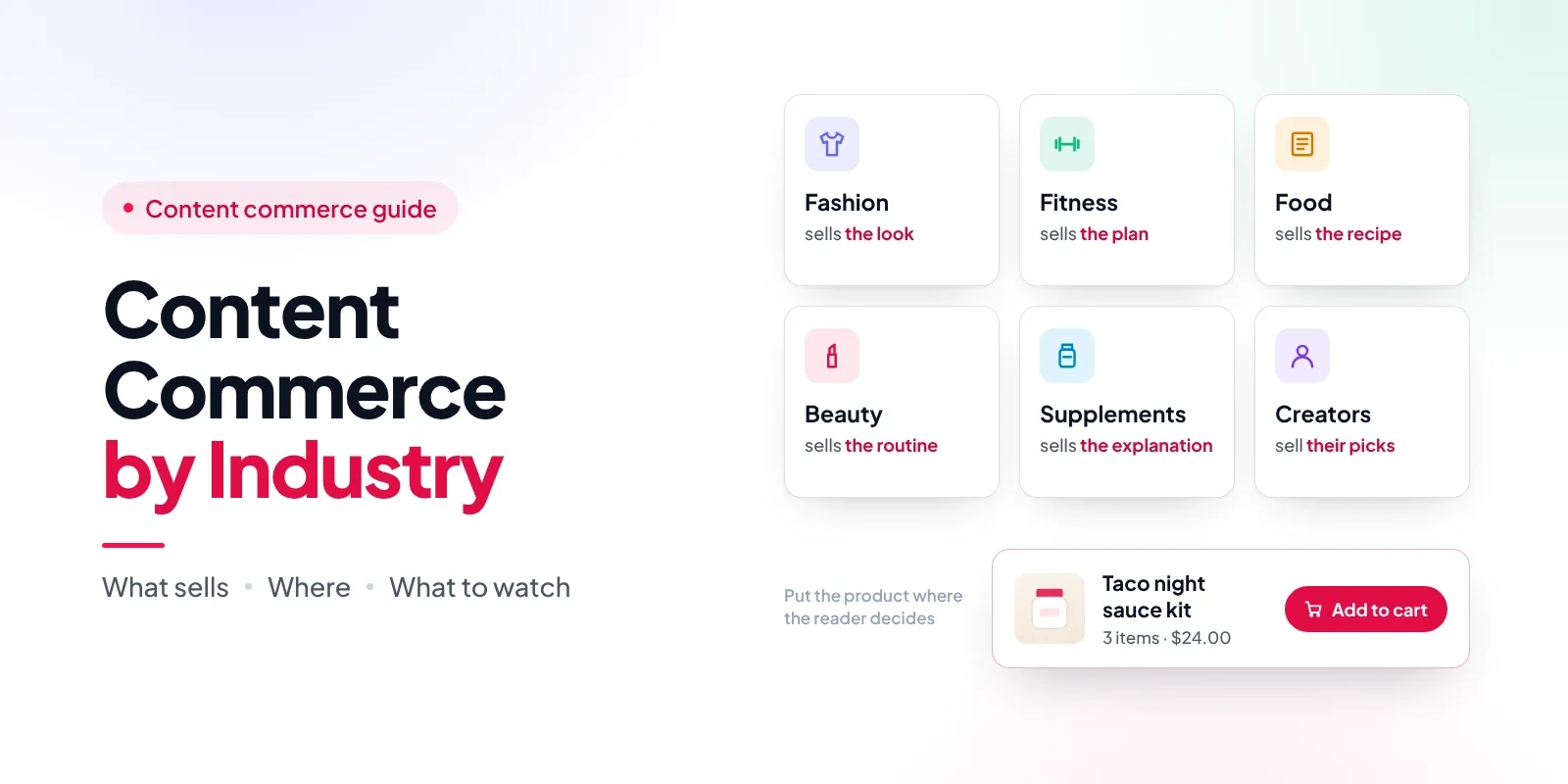
Fashion brands sell the look, food brands sell the recipe, and supplement brands sell the explanation. Here's how six industries use content commerce, what to put on the page, and what to watch in each.
24 min read
 Embed Shopify Products
How to Make a Shoppable Holiday Gift Guide Readers Can Buy From
Last checked: 2 November 2026, against the EmbedUp App Store listing, embedup.com, ShipStation's 2026 holiday shipping deadlines, and the NRF 2026 holiday forecast. Who this is for: Shopify merchants, bloggers, and content teams who publish a holiday gift guide on a blog or website. Reading time: about 16 minutes.
17 min read
 Embed Shopify Products
How to Make Money From a Makeup Blog With Shopify (2026 Guide)
Learn how beauty bloggers can turn makeup tutorials, reviews, and product recommendations into earning opportunities. Discover five common challenges of selling Shopify products through blogs and how EmbedUp helps merchants and bloggers create shoppable content, manage affiliate partnerships, and track sales.
16 min read